Home›Sufism in the Deccan›Bandanawaz Gisudaraz
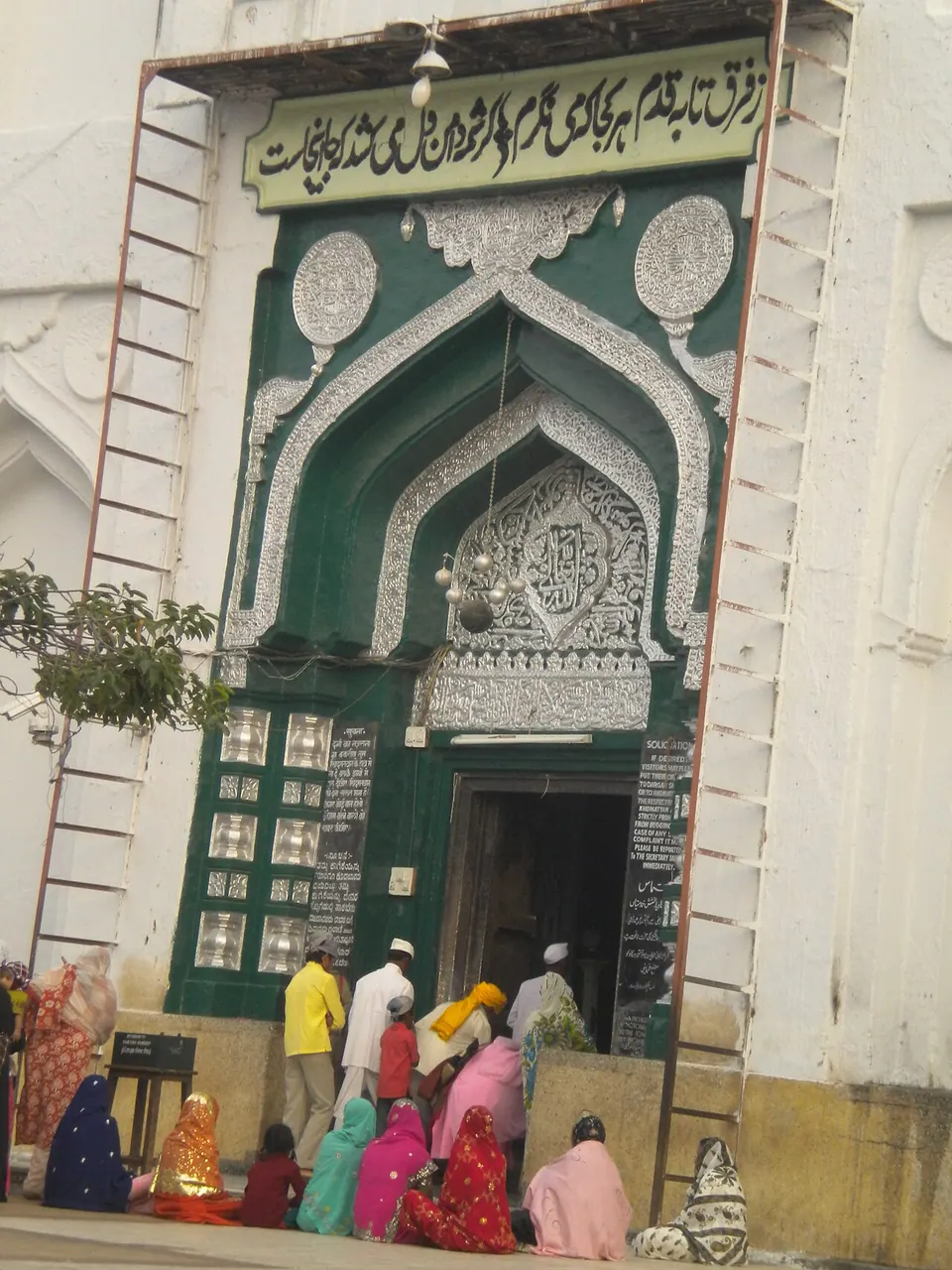
The most learned Sufi of the medieval Deccan
A Husayni Sayyid who took khilafat from Chiragh-i-Delhi, the last great Chishti of the north
Khwaja Sayyid Muhammad Husayni Gesudaraz Bandanawaz (b. Delhi 721 AH / 1321 CE; d. Gulbarga 825 AH / 1422 CE) is, by general agreement, the most learned and the most influential Sufi of the medieval Deccan. A Sayyid by descent (the family traced its lineage to Imam Husayn ibn 'Ali), born in Delhi and raised at Daulatabad after his family migrated south with Muhammad bin Tughluq's transfer, he returned to Delhi to study under Khwaja Nasir al-Din Chiragh-i-Delhi (d. 1356), the chief Chishti successor to Nizamuddin Awliya. He received khilafat from Chiragh-i-Delhi himself.[1,2]
A library in one lifetime
Quranic commentary, hadith and fiqh — and the earliest surviving prose in Dakhni
His scholarly output is the most extensive of any pre-modern Deccan Sufi. More than a hundred works are attributed to him, of which around thirty survive: commentaries on the Qur'an, treatises on hadith, manuals of Hanafi fiqh, expositions of the works of Ibn al-'Arabi, his own collected discourses (the Javami' al-Kalim, compiled by his disciple Sayyid Muhammad Akbar Husayni). He also wrote some of the earliest preserved prose in Dakhni Urdu — the Mi'raj al-'Ashiqin ("The Ascension of the Lovers"), a guide for spiritual seekers in the southern vernacular — making him a foundational figure in Dakhni literary history as well as in Sufism.[2,3]
The hospice at Gulbarga
An honoured but independent saint at the court of Firuz Shah Bahmani, and the shrine that outlived them both
At the invitation of the Bahmani sultan Firuz Shah Bahmani he moved to Gulbarga in 1399 and established his hospice there. His relationship with the sultan was respectful but independent: when Firuz Shah sought political endorsement, Bandanawaz declined and gave his blessing to the sultan's younger brother (the future Ahmad Shah I) instead. He died at Gulbarga in 1422 at the age of 101 (lunar) and was buried at his hospice. His dargah, built by Ahmad Shah I and successively enlarged, remains the largest Sufi shrine in the southern Deccan and the most-visited dargah in modern Karnataka. The annual 'urs, observed in the Islamic month of Dhu'l-Qa'da, draws hundreds of thousands of pilgrims.[1,4]
Bandanawaz Gisudaraz in dates
- 1321Born in Delhi (721 AH) to a family of Husayni Sayyids; given the epithet Gesudaraz ("long-tressed") and later Bandanawaz ("cherisher of the poor").[1]
- c. 1327Family migrates to Daulatabad following Muhammad bin Tughluq's forced transfer of Delhi's population to the new southern capital.
- c. 1340sReturns to Delhi and enters the circle of Khwaja Nasir al-Din Chiragh-i-Delhi, the last great Chishti master of the north and chief successor to Nizamuddin Awliya.
- 1356Nasir al-Din Chiragh-i-Delhi dies; Bandanawaz carries his khilafat forward and becomes the principal Chishti spiritual heir in the Deccan.
- c. 1380sAuthors the Mi'raj al-'Ashiqin, a guide for spiritual seekers in Dakhni Urdu — among the earliest surviving prose compositions in the southern vernacular.
- c. 1390sScholarly corpus — Quranic commentaries, hadith treatises, Hanafi fiqh manuals, and expositions of Ibn al-'Arabi — grows to over a hundred attributed works; around thirty survive.
- 1399Accepts the invitation of Bahmani Sultan Firuz Shah Bahmani and moves to Gulbarga, establishing his khanqah there.[4]
- c. 1405Declines to give political endorsement to Firuz Shah; instead bestows his blessing on the sultan's younger brother, the future Ahmad Shah I Bahmani.
- 1422Dies at Gulbarga (825 AH) at the age of 101 lunar years; interred at his hospice, which Ahmad Shah I converts into a dargah.[1]
- Post-1422The dargah is enlarged by successive Bahmani and later rulers; it becomes the largest Sufi shrine in the southern Deccan.
- AnnualThe 'urs observed each year in Dhu'l-Qa'da draws hundreds of thousands of pilgrims; the dargah remains the most-visited Sufi shrine in modern Karnataka.
References
- ^ ^ ^ ^ ^ ^ Richard M. Eaton, "Gīsūdarāz, Sayyed Moḥammad Ḥosaynī," Encyclopaedia Iranica, Vol. XI, Fasc. 1. ↗
- ^ ^ Carl W. Ernst & Bruce B. Lawrence, Sufi Martyrs of Love: The Chishti Order in South Asia and Beyond, Palgrave Macmillan, 2002.
- ^ Richard M. Eaton, A Social History of the Deccan, 1300–1761: Eight Indian Lives, Cambridge University Press, 2005.
- ^ ^ H. K. Sherwani & P. M. Joshi (eds.), History of Medieval Deccan (1295–1724), 2 vols., Government of Andhra Pradesh, Hyderabad, 1973–74.
Compiled and edited by Syed Azhar Farhan for Dakhni.org from the sources cited on this page. AI may assist research and drafting; see the editorial method, corrections log, and AI policy.
Comments
Comments are provided by Disqus. Loading them shares your visit with Disqus.