Home›Cities of the Deccan›Bidar
A new capital on the plateau
Ahmad Shah Wali leaves Ahsanabad and renames Bidar Muhammadabad
For seventy-two years the Bahmani Sultanate had ruled from Gulbarga — the city its founder Hasan Bahman Shah had styled Ahsanabad. By the 1420s its citadel had grown crowded, its water table had drawn down, and a long famine had emptied its districts. The ninth sultan, Ahmad Shah I Wali (r. 1422–1436), a saintly king said to be a disciple of the Sufi Khwaja Banda Nawaz, decided on a new seat — north-east, on the high basalt plateau, at the small fortified town of Bidar.
The move was made in stages between 1429 and 1432. The sultan rebuilt the old Hindu fort entirely — laying out a triangular citadel of red laterite, raising a treble moat cut into living rock, and within the walls a Solah Khamba (sixteen-pillared) congregational mosque, a Diwan-i-Khas, and the foundations of what would later be the Rangin Mahal and the Tarkash Mahal.
On the plateau outside the fort he laid out the new town in a Persian quadripartite plan, with bazaars converging on the Chaubara — a circular three-storeyed watchtower that still stands at the centre of old Bidar. The court records styled the city Muhammadabad-Bidar; the chroniclers, characteristically, kept calling it Bidar.[1]
A citadel of red laterite
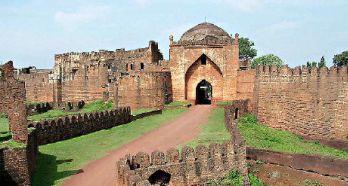
Thirty-seven bastions, seven gates, a treble moat
The Bidar Fort is unusual among Indian forts in being cut almost entirely from one geological event: the Deccan Trap basalt. The architects of Ahmad Shah used the natural cliff line on three sides and excavated a deep moat — in places more than thirty feet — directly out of the rock, on the fourth. The earth so removed was laid in courses faced with red laterite to make the outer rampart.
The plan is irregular, roughly triangular, with a circuit wall of about four kilometres, thirty-seven bastions and seven principal gates: the Sharza Darwaza ("lion gate") at the south-east, the Gumbad Darwaza, the Mandu Darwaza and the Kalmadgi Darwaza among them. The gates themselves are double, with right-angle dog-leg passages designed to prevent a charging cavalry from gaining the inner courtyard.
Within the outer enceinte stand the Royal Pavilions — Tarkash Mahal, Gagan Mahal, Rangin Mahal, Takht Mahal — together with the Solah Khamba mosque, the Diwan-i-Khas, the Lal Bagh, and the Naubat Khana from which the daily nine notes of the kettledrum announced the sultan's audience. It is the largest surviving Bahmani complex anywhere in the Deccan.[2]
A Persian college on a Deccan plateau
The wazir who built — and was beheaded for his loyalty
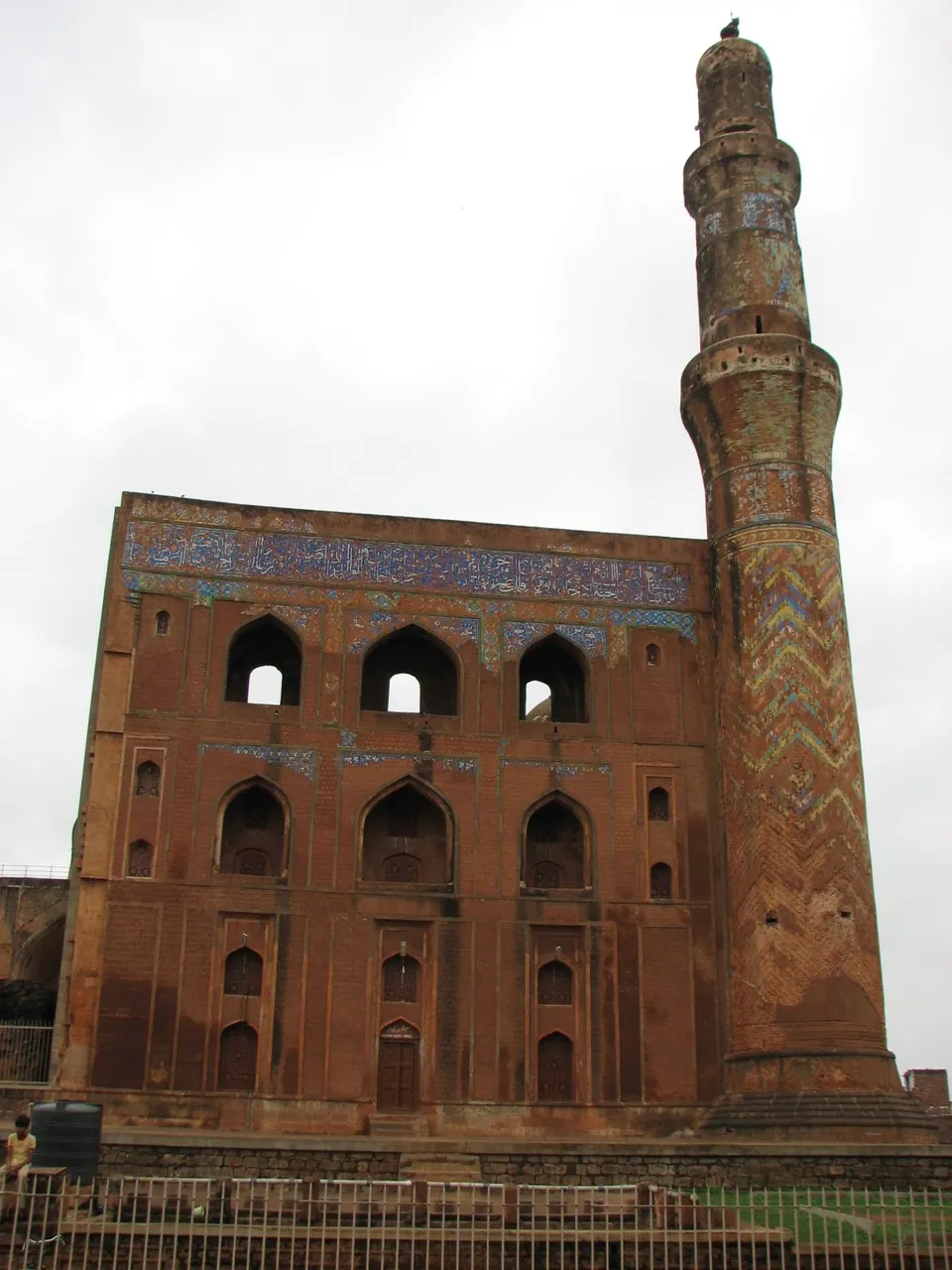
Mahmud Gawan (1411–1481) was a Persian merchant from Gilan who arrived in Bidar in 1453, rose to be the chief minister of the Bahmani sultanate under Muhammad Shah III, and gave the kingdom its single most ambitious decade — from the conquest of Goa in 1472 to the annexation of the Konkan and Vijayanagara's western marches.
In 1472 he founded, at his own expense, a three-storeyed madrasa in the new city — modelled on the great Khargird madrasa of Khorasan, faced in glazed turquoise, indigo and white tile, with a thirty-metre minaret at each corner and a great central iwan of intersecting arches. It held a library of 3,000 volumes, lecture halls for theology, mathematics, astronomy and medicine, and a residence for visiting scholars from Samarkand, Shiraz and Cairo.
In 1481 the Deccan nobles, jealous of his foreign rank, forged a letter to Vijayanagara in his hand. Muhammad Shah, drunk that night, ordered his execution; he was beheaded at the age of seventy-eight. He had asked only that his shroud be made from the cloth of his counting-room. The Bahmani state never recovered. The madrasa stood — until in 1696, a Mughal magazine stored inside it exploded during a thunderstorm, sheering away one minaret and half the façade. The remaining minaret still leans, blue-tiled, over the ruined courtyard.[3]
Twelve sultans under twelve domes
A line of mausolea on the road to Holkonda
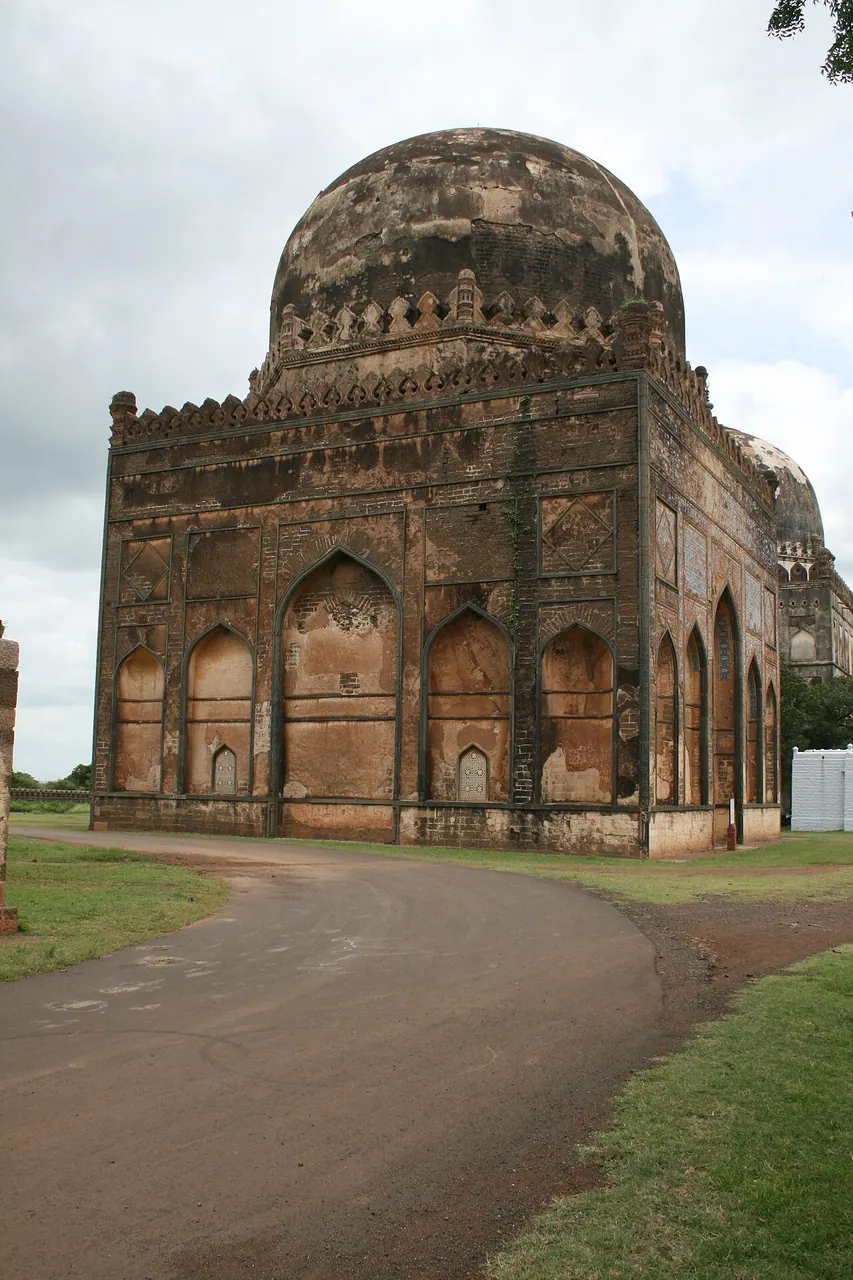
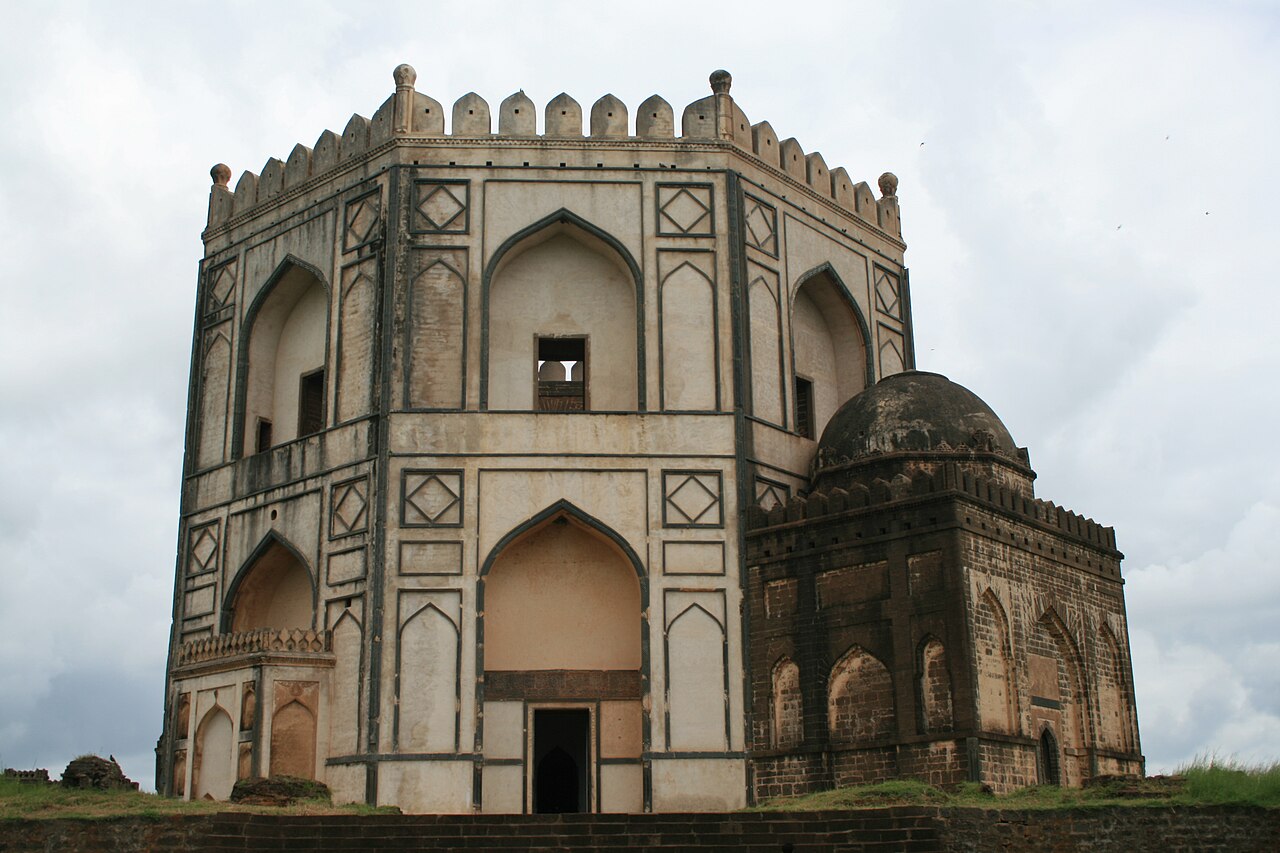
Three kilometres east of the fort, the Bidar–Holkonda road passes a row of vast bulbous domes set in a walled garden — the Ashtur necropolis. Twelve sultans of the Bahmani line, from Ahmad Shah Wali (d. 1436) to Kalimullah Shah (d. 1538), are interred here, alongside their consorts and a constellation of princes.
The earliest tomb — that of Ahmad Shah Wali himself — is the most painted royal interior of fifteenth-century India: every spandrel and every soffit covered, ground to summit, in gold-on-cobalt Persian calligraphy and floral arabesque. The chronicler Tabataba records that the work was done by craftsmen sent from Herat by the Timurid prince Shah Rukh, in respect of the dead sultan's piety. Ahmad Shah Wali is venerated as a saint to this day; his urs is observed every November.
The later tombs grow progressively larger and starker, culminating in the colossal twin-shelled dome of Alauddin Ahmad II (d. 1458), then become smaller and rougher as the dynasty itself contracts under the Barids. The last tomb of any size, that of Mahmud Shah (d. 1518), is half the diameter of the founder's. The architecture follows the politics with painful exactness.[4]
When the wazirs became kings
Qasim Barid, his sons, and the smallest of the Deccan sultanates
By the 1490s the Bahmani sultanate was a fiction. The four corner provinces — Berar, Bijapur, Ahmadnagar and Golconda — had each declared themselves under their Bahmani governors. Bidar itself, with its rump revenue and the captive sultan, fell under the protectorship of Qasim Barid, the Turkish-born Mir Jumla who had risen from a slave to the highest office of state. From 1492 he ruled as amir, never quite as sultan; his successors were less circumspect.
His son Amir Barid (r. 1504–1542) and his grandson Ali Barid Shah I (r. 1542–1580) finally adopted the royal style. The dynasty that resulted — the Barid Shahis — was the smallest of the five Deccan successor states, but the most intricate in ornament. Ali Barid in particular was a scholar, a calligrapher and a connoisseur: he translated the Khamsa of Nizami into Dakhni, patronised the painter Farrukh Beg, rebuilt the Rangin Mahal, and constructed his own tomb-garden a mile west of the fort, with a great open-domed mausoleum in the Persian Charbagh manner.
Five Barid Shahi sultans followed Ali; the line was extinguished in 1619 when Ibrahim Adil Shah II of Bijapur deposed Amir Barid III and annexed the territory. The Barid Shahi tombs, eight in all, lie in a single garden west of the city — domed octagons in chunam stucco, calligraphic, almost feminine after the elephantine masses at Ashtur.[5]
A court of tile and timber
Rangin Mahal, Takht Mahal, Tarkash Mahal — the palaces inside the citadel
The Rangin Mahal ("painted palace") is the jewel of the fort interior. Begun under the late Bahmanis and rebuilt almost entirely by Ali Barid I around 1560, it is constructed of teak and rosewood pillars carved with running scrolls of palmette and lotus, walls inlaid with mother-of-pearl in geometric arabesque, and dadoes faced with the same imported turquoise tile as the Mahmud Gawan madrasa. The audience-hall ceiling is a single field of plaster-relief muqarnas. It is the finest small palace of the Deccan plateau.[4]
Beyond it lies the Takht Mahal — the coronation hall, a four-iwan court with traces of dark-cobalt tile in the spandrels — and behind that the Tarkash Mahal, named for the quivers of its Turkish bodyguard, with its peculiar central chimney that betrays the mountain origins of the women who lived there.
Outside the palace court rises the Solah Khamba Masjid, a sixteen-pillared mosque begun in 1423 — making it among the earliest dated buildings on the Bidar plateau, predating the move of the capital itself. A small graveyard at its rear holds the tomb of Hazrat Multani Padshah, a Sufi of the Suhrawardi order who taught here under Ahmad Shah Wali.
Black metal, silver inlay
A six-hundred-year tradition that takes the city's name
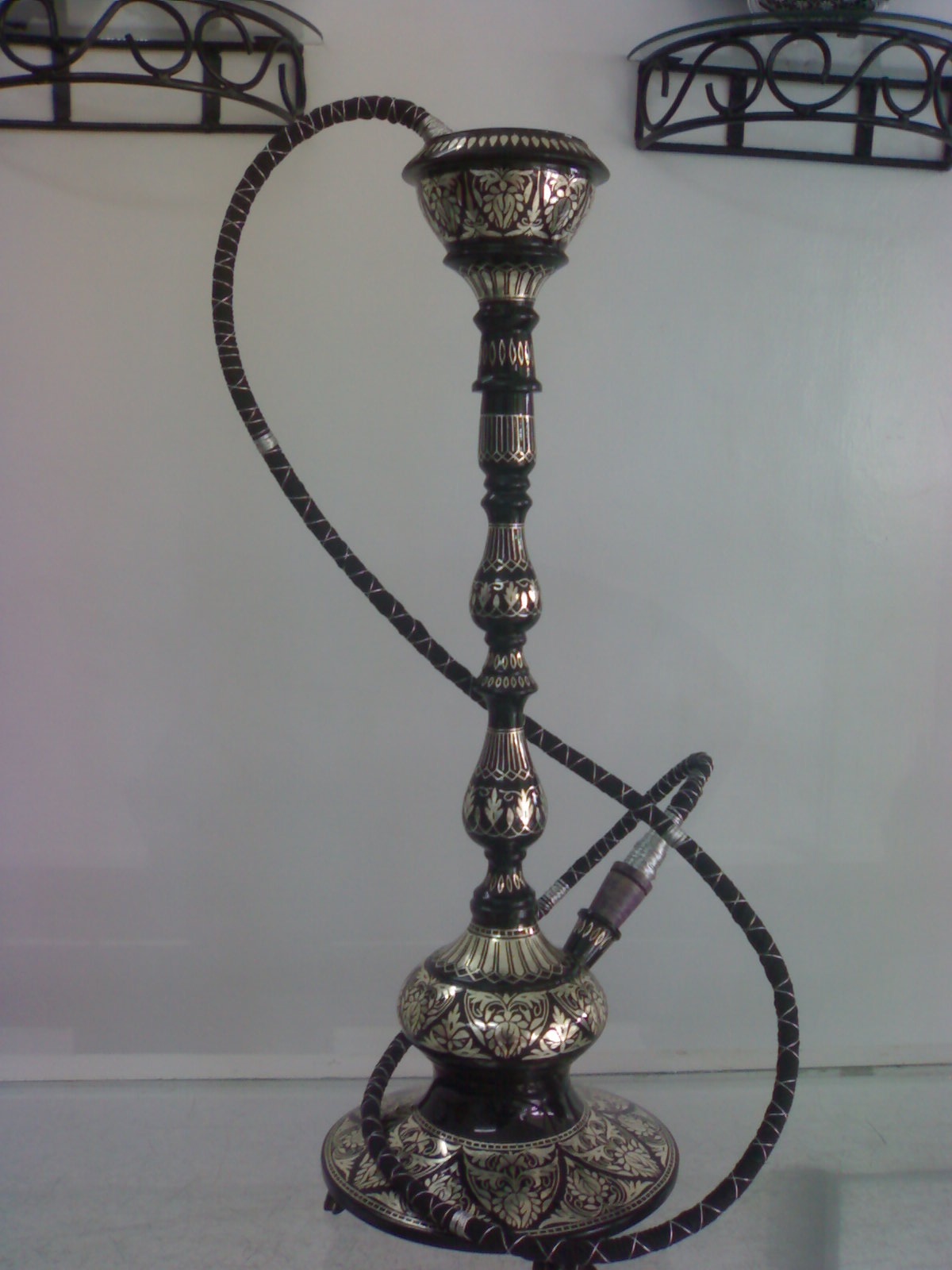
Bidriware — known across the Indian Ocean simply as Bidri — is a metalcraft developed in this city under the late Bahmani court, around the fourteenth century. Tradition gives its origin to Khwaja Moinuddin, a Persian artisan brought by Ahmad Shah Wali. The body alloy is unusual: roughly 95 parts zinc to 5 parts copper, cast cold and worked when warm. Designs are engraved into the surface, fine wire of pure silver (and sometimes gold) is hammered into the grooves, and the piece is then immersed in a paste of soil from the Bidar Fort itself — soil rich in oxidised salts that, alone in India, blackens the body alloy permanently while leaving the silver bright.
Mughal envoys took Bidri pieces home as gifts. Tavernier saw them in the bazaar in 1670 and bought a hookah-base for the queen of France. Persian inscriptions on the early pieces sometimes name the maker; the late nineteenth-century pieces, by contrast, are anonymous and almost industrial.
Bidriware received Geographical Indication protection in 2006 and is still made by hand in Siddiq Talim and the Daulat-ul-Islam quarter of the old city. The soil for the blackening paste is, by tradition, drawn only from inside the unrestored portion of the Bidar Fort itself — a chemical fact and a civic poetry both.
From kingdom to district
The civic life of Bidar after the loss of independence
In 1619 Ibrahim Adil Shah II of Bijapur deposed the last Barid and incorporated the city into his own kingdom; for thirty-eight years Bidar was an Adil Shahi sarkar, governed from Bijapur, with a Bijapuri kotwal in the fort. In 1656–57 the future emperor Aurangzeb, then Mughal viceroy of the Deccan, captured the fort after a short siege, renamed the city Zafarabad in his customary triumphalism, and incorporated it into the Mughal subah.
In 1724 it passed peacefully — with the rest of the imperial Deccan — into the hands of Mir Qamar-ud-Din Khan, Asaf Jah I, the founder of the Hyderabad Nizamate. From that year until 1948, Bidar was a district of Hyderabad State; the fort served as the residence of the local Talukdar, the Bahmani tombs were maintained from a small endowment of the seventh Nizam, and the Bidri craftsmen filled royal commissions for the durbar at Chowmahalla.
At the States Reorganisation of 1956, the Kannada-speaking parts of the old Hyderabad State, Bidar among them, were transferred to Mysore (now Karnataka). The city today is a quiet district headquarters of about 220,000 people; the fort and the madrasa are protected by the Archaeological Survey of India; the Bahmani complex at Ashtur was extensively restored between 2010 and 2020 by the Aga Khan Trust for Culture and the State Department of Archaeology.[2]
بیدر کے قلعے میں رنگوں کا محل،
سنگ سیاہ، چاندی کی لہر، اور وقت کی غزل
"In Bidar's fort the palace of colours stands,
black stone, silver waves, and a ghazal of time."
— After Ali Barid Shah I, c. 1565
Bidar in dates
- c. 1322Bidar — then a small Kakatiya hill-fort — captured by Ulugh Khan (the future Muhammad bin Tughluq) for the Delhi Sultanate.
- 1347Hasan Bahman Shah founds the Bahmani Sultanate at Gulbarga; Bidar a frontier fortress under his governor.
- 1422Ahmad Shah I Wali succeeds as the ninth Bahmani; orders the rebuilding of the Bidar fortress.
- 1429–1432Capital formally transferred from Gulbarga to Bidar; the city renamed Muhammadabad-Bidar.
- 1436Death of Ahmad Shah Wali; first tomb at the Ashtur necropolis raised.
- 1453Mahmud Gawan arrives in Bidar from Gilan; rises to be wakil-us-saltanat.
- 1472Mahmud Gawan founds his madrasa — three storeys, four minarets, a library of 3,000 manuscripts.
- 1481Mahmud Gawan executed on a forged letter; the Bahmani state begins to fragment.[3]
- 1490The four corner provinces — Berar, Bijapur, Ahmadnagar, Golconda — declare independence.
- 1492Qasim Barid begins the long Barid protectorate over the rump Bahmani state.
- 1538Death of Kalimullah Shah, last Bahmani sultan; the line ends.
- 1542Ali Barid Shah I assumes the royal title — the Barid Shahis become a sovereign dynasty.
- c. 1560Ali Barid rebuilds the Rangin Mahal in tile and mother-of-pearl.
- 1619Ibrahim Adil Shah II of Bijapur annexes Bidar; the last Barid, Amir Barid III, is taken in chains to Bijapur.[5]
- 1656The Mughal prince Aurangzeb captures the fort; Bidar incorporated into the Mughal subah of the Deccan, briefly renamed Zafarabad.
- 1696A lightning strike on a powder magazine inside the Mahmud Gawan Madrasa shears away one minaret and half the façade.
- 1724Bidar passes to Asaf Jah I; for the next 224 years it is a district of Hyderabad State.
- 17 Sept 1948Operation Polo concludes; Bidar accedes to the Indian Union with the rest of Hyderabad State.
- 1 Nov 1956States Reorganisation transfers the Kannada-speaking districts, Bidar among them, to Mysore (Karnataka).
- 2006Bidriware receives Geographical Indication status under Indian law.
- 2014–2024Restoration of the Ashtur tombs and the fort palaces by the Aga Khan Trust for Culture and the Karnataka State Archaeology Department.
References
- ^ ^ Haroon Khan Sherwani, The Bahmanis of the Deccan: An Objective Study, Munshiram Manoharlal, New Delhi, rev. ed. 1985.
- ^ ^ UNESCO Tentative List, "Monuments and Forts of the Deccan Sultanate." ↗
- ^ ^ Richard M. Eaton, A Social History of the Deccan, 1300–1761: Eight Indian Lives, Cambridge University Press, 2005 — ch. 2, "Mahmud Gawan: The Careerist as Cosmopolitan."
- ^ ^ George Michell & Mark Zebrowski, Architecture and Art of the Deccan Sultanates (The New Cambridge History of India I.7), Cambridge University Press, 1999.
- ^ ^ H. K. Sherwani & P. M. Joshi (eds.), History of Medieval Deccan (1295–1724), 2 vols., Government of Andhra Pradesh, Hyderabad, 1973–74.
Compiled and edited by Syed Azhar Farhan for Dakhni.org from the sources cited on this page. AI may assist research and drafting; see the editorial method, corrections log, and AI policy.
Comments
Comments are provided by Disqus. Loading them shares your visit with Disqus.