Home›Cities of the Deccan›Golconda
A hill called Golla Konda
From a herder's clay shrine to a Kakatiya outpost
The fortress takes its name from the Telugu Golla Konda — "the shepherds' hill." Local tradition, recorded in the seventeenth-century Tarikh-i-Sultan Muhammad Qutb Shah, places its origin in the discovery of a small idol on the bare granite slope by a cowherd boy of the Yadava (Golla) caste; he reported it to the Kakatiya king at Warangal, who built a clay shrine on the spot and posted a guard there. The hill was on a natural pass between the Musi valley and the gold-bearing tracts to the north, and it never fell back into obscurity.
By the late twelfth century it carried a small Kakatiya watch-tower, called Mankal. After the Tughluq sack of Warangal in 1323 the post passed first to the Delhi Sultanate, then in 1364 to the Bahmani sultans, who garrisoned it as a frontier fortress against Vijayanagara. The Bahmani governor Quli Qutb Mulk (later Sultan Quli) was given charge of it in 1496; he found a small mud-and-rubble fort on a hill of black granite, and a village of perhaps a thousand souls.
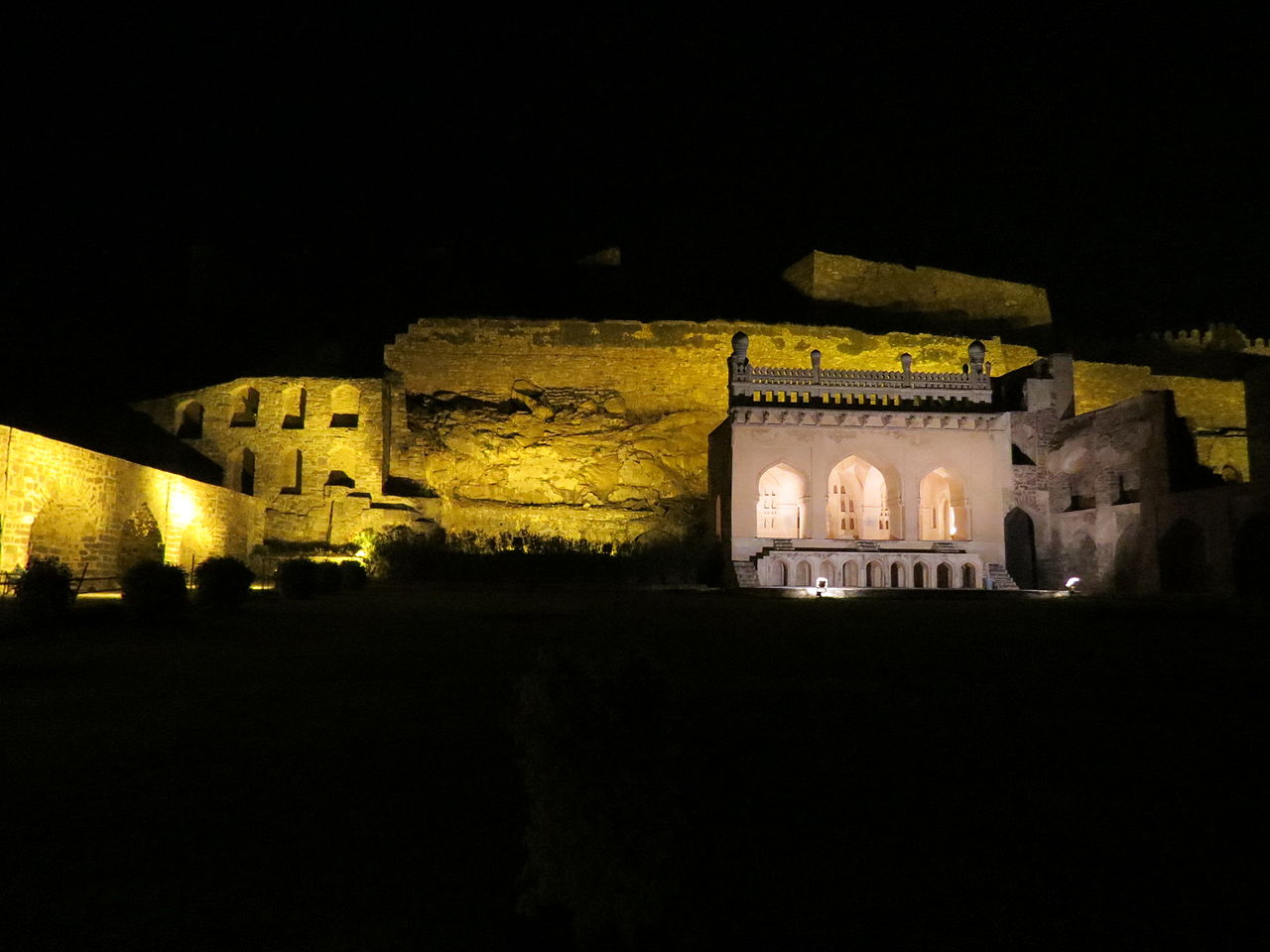
The hill itself is striking: a single isolated dome of basement gneiss, four hundred metres in diameter, rising a hundred and twenty metres above the surrounding plain. Its summit catches every breeze — the Bala Hisar pavilion built later sits in a permanent draught — and the natural rock terraces that stair its flanks turned out, in the hands of fifteenth-century engineers, to be the perfect bones for a citadel.[1]
The Bahmani vassal who became a sultan
From Hamadan to the throne of Golconda
Sultan Quli was a Qara Qoyunlu Turcoman noble born in Hamadan around 1470, who came south as a young man to enter the service of the Bahmani sultan Muhammad Shah III. He rose through the cavalry, distinguished himself in campaigns against Vijayanagara, was given the title Qutb-ul-Mulk ("pole-star of the kingdom") around 1490, and was appointed governor of Telangana in 1496 with his seat at the small fort of Mankal. As the Bahmani state collapsed, Sultan Quli held the eastern Deccan together by sheer prestige; in 1518, on hearing of the murder of the last effective Bahmani sultan, he proclaimed independence at Golconda and founded the dynasty that would bear his old title — the Qutb Shahis.
He ruled for an extraordinary forty-five years, dying at the age of ninety-nine in 1543 — assassinated, the chronicles claim, in his bed at the morning prayer, on the orders of his own son Jamshid. He had spent those decades remaking the rubble fort. The mud walls were rebuilt in dressed granite, the circuit extended around the entire base of the hill (eleven kilometres in all, with eight gates and eighty-seven bastions), and a planned town of mosques, bazaars and noble houses was laid out on the level ground to the west and south. By his death the citadel was already what English traders, half a century later, would call "the strongest place in all the East."
The dynasty he founded would last seven sultans and one hundred and sixty-nine years. Each contributed his own building — Ibrahim's reservoirs, Muhammad Quli's parade ground, Abdullah's audience hall, Tana Shah's gardens — but the spine of the fortress, and the protocol of its court, were Sultan Quli's work.[2]
A clap that climbs a kilometre
Four concentric walls, a hidden water-system, and a whispering gate
The fort is laid out in four concentric defensive zones. The outermost Naya Qila ("new fort") is a great walled enclosure to the north, built by Abdullah Qutb Shah in the 1650s to absorb the artillery duels of the late wars. Inside it the original Petla Burj circuit ringed the city of Golconda proper. A third wall of dressed granite — the one Sultan Quli ordered — wraps the base of the hill itself; a fourth, much higher, climbs to the Bala Hisar, the citadel pavilion at the summit. From any of these you walk inwards through gates set at sharp angles to one another, so that no battering-ram could be charged in a straight line and no elephant brought to bear.
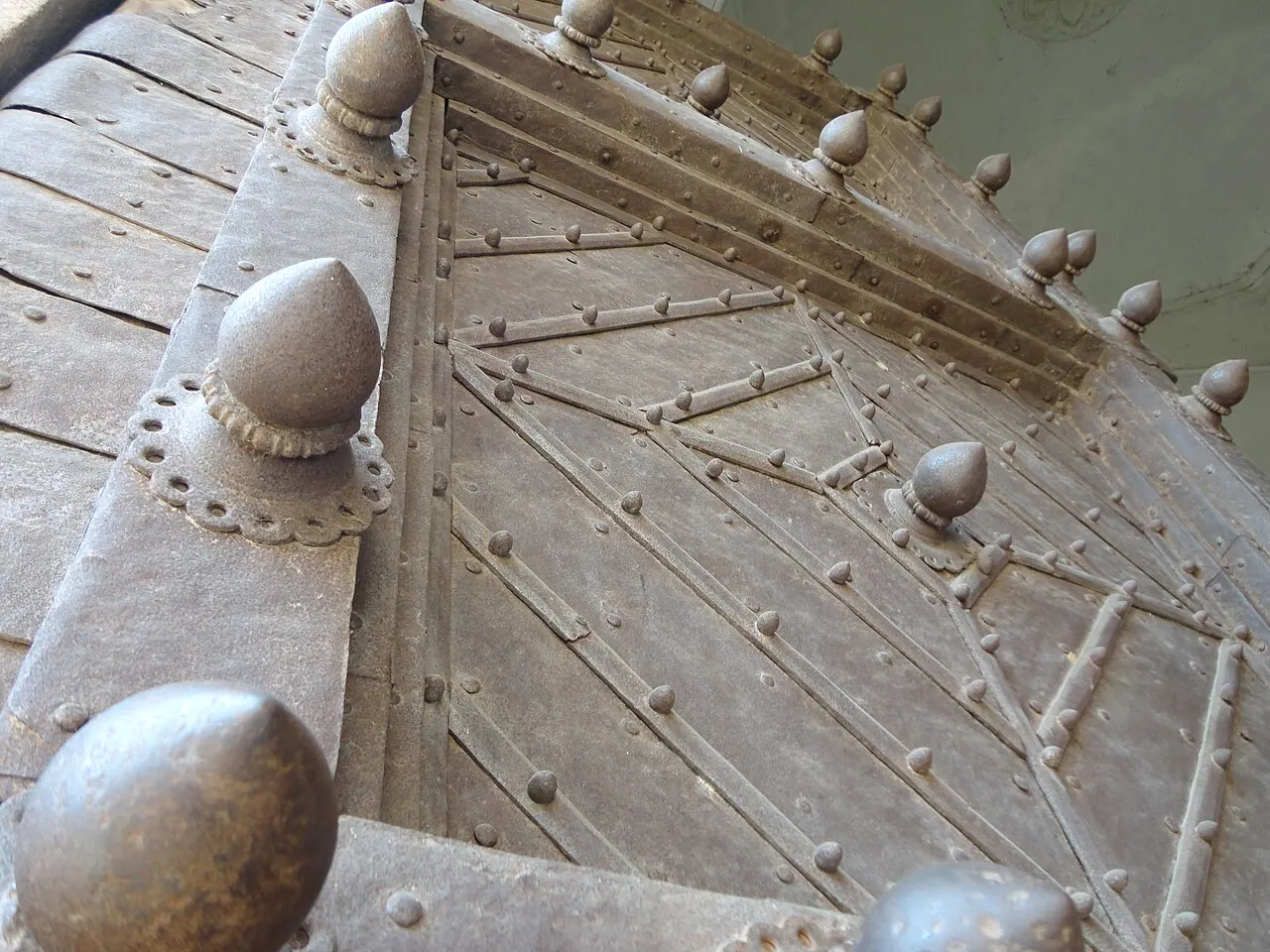
The most-told feature is the acoustic system at the Fateh Darwaza ("the gate of victory"), the principal southern entrance. The high arch over the gate is shaped as a hemispherical dome; a hand-clap at its centre is focused, by reflection, into a beam of sound that travels up the natural shaft of the rock and is heard, eight to ten seconds later, in the small Naqqarkhana drum-room a kilometre away on the summit. It was used as an early warning: the moment an unwelcome arrival passed the gate, the captain of the guard at Bala Hisar knew. The dome is still there, the clap still works, and tourist guides still demonstrate it half a dozen times a day.
Equally remarkable is the hydraulics. There is no spring on the granite hill. Water for the upper terraces was lifted by a system of Persian wheels in series — five lifts in all, each driven by oxen turning a vertical shaft — drawing from the Hayat Bakshi tank below and feeding a network of stone channels and cisterns at the summit. The system worked continuously for almost two hundred years.[3]
Where every great stone began
Until 1730, the only diamond mines on earth
From at least the fourth century BCE until the discovery of Brazilian alluvials in 1725, the only commercially exploited diamond fields on earth were the gravel beds of the Krishna and Penner rivers — chiefly at Kollur, Paritala, Atkur, Wajra Karur and Banaganapalle — all within four hundred kilometres of Golconda. The fort gave its name to the trade. Every diamond, no matter where mined, was brought up to Golconda to be weighed, cleaved, sold and registered; and the term "a Golconda diamond" came to mean simply a diamond of the first water.
The trade was an imperial monopoly. The Qutb Shahis took an octroi at the gates, a percentage on cut and uncut stones, and a right of first refusal on any stone above twenty ratis (about 2.4 g). In 1645 the Frenchman Jean-Baptiste Tavernier, on the second of his six journeys to India, was admitted to the mines. His Six Voyages (Paris, 1676) records that 60,000 men, women and children worked the Kollur diggings under one master, that the stones were paid for in cowries, that the pit-works went down twelve to fourteen feet, and that the largest diamond he saw in Mir Jumla's hands weighed 793 carats rough — almost certainly the same stone that became the Koh-i-Noor.
The diamonds left the Deccan along the great caravan-route to the Coromandel coast, embarked at Masulipatnam, and travelled on Dutch and Armenian ships to Surat, Hormuz and (from the 1660s) directly to Amsterdam. The whole edifice of European jewellery, from the Crown of England to the Crown of France, ultimately rested on this single piece of Telangana gravel.[4]
Diamonds out of Golconda
Every one of these passed through the gates of the fort
The "Mountain of Light." Mined at Kollur, possibly by 1300; in Qutb Shahi treasury until taken by Aurangzeb in 1656; later seized by Nadir Shah at Delhi in 1739, by Ranjit Singh at Lahore, and by the British East India Company in 1849.
Tower of London · UKThe deep-blue stone Tavernier carried to France as the "Tavernier Blue" in 1668. Sold to Louis XIV; recut and stolen during the French Revolution; resurfaced in London in 1839 in the collection of Henry Philip Hope.
Smithsonian · WashingtonFound at Paritala in 1698 by an Indian slave who concealed it in a leg-wound. Sold to Thomas Pitt, Governor of Madras; cut in London 1704–06; bought by the Duke of Orléans in 1717. Worn by Marie Antoinette and set in Napoleon's sword-hilt.
Louvre · ParisSaid to have been the eye of an idol at Sri Ranganatha at Srirangam. Smuggled out by a French deserter, sold across Europe, and given by Count Grigory Orlov to Catherine the Great in 1773 as part of his bid to win her back.
Kremlin Diamond Fund · MoscowThe "Sea of Light." A pale-pink table-cut stone, originally part of the same rough as the Nur-ul-Ain. Taken from Delhi by Nadir Shah in 1739 along with the Peacock Throne; held by every Iranian dynasty since.
Central Bank of Iran · TehranThe "Light of the Eye." Pink Kollur stone; cut from the same rough as the Daria-i-Noor; mounted in the tiara of Empress Farah for her 1958 coronation.
Central Bank of Iran · TehranA peach-pink Kollur stone bought by Tavernier and sold to Louis XIV in 1669. Named for Hortense de Beauharnais. Stolen with the rest of the French crown jewels in 1792, recovered, and now displayed beside the Regent.
Louvre · ParisThe largest stone Tavernier ever saw — measured by him at Aurangzeb's court in 1665 — almost certainly the rough that yielded the Koh-i-Noor. Its later fate is unknown; it may have been recut and broken up.
Lost · last seen 1665Seven domes for seven sultans
A garden city of the dead, half a kilometre north of the fort
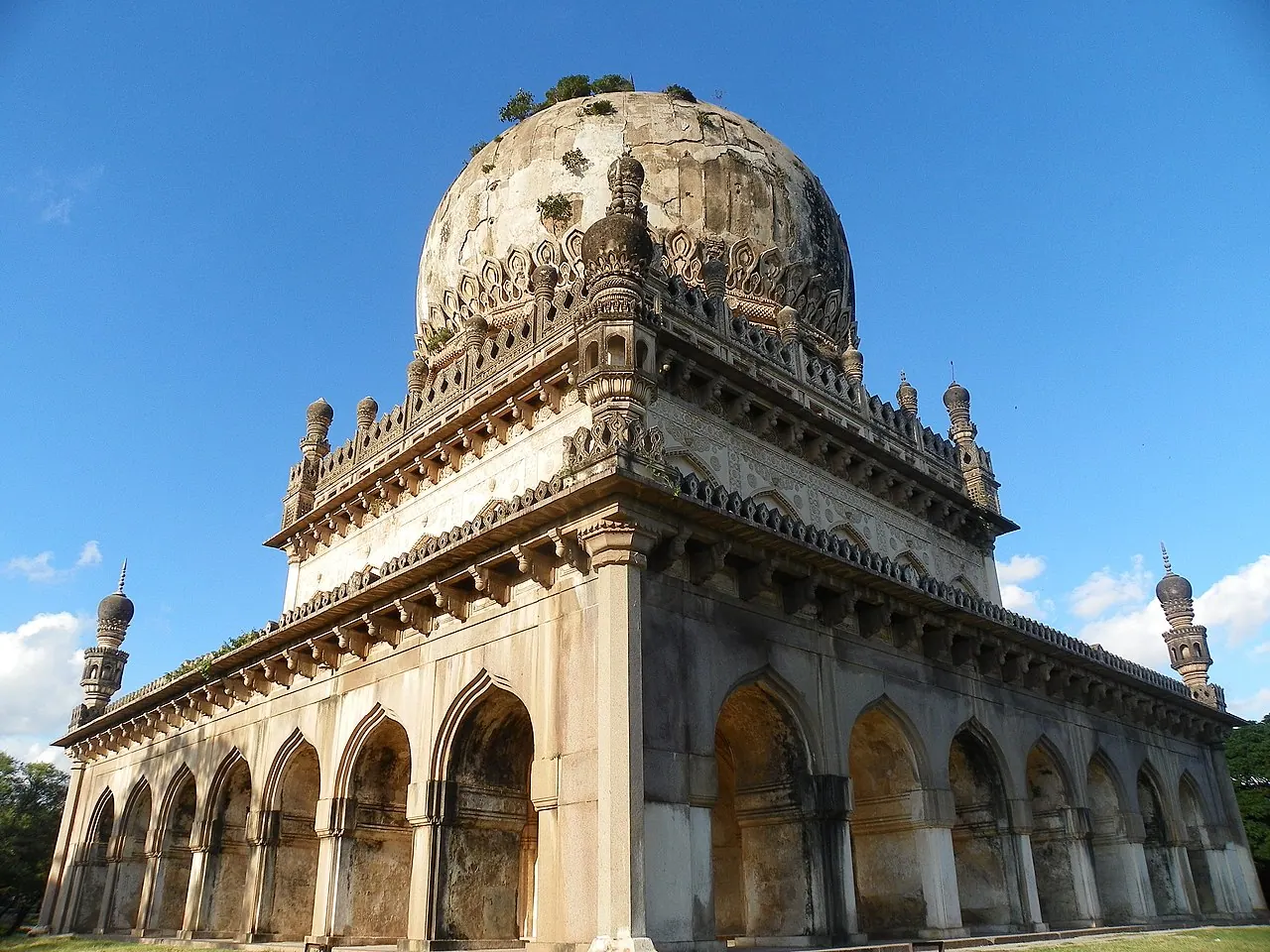
Half a kilometre to the north of the citadel, on what was open scrubland in 1543, lies the Qutb Shahi Maqbara — a walled garden of fifty-odd domed tombs grouped around the larger mausolea of the seven sultans. Sultan Quli's, the earliest, is the smallest: a square chamber on a low chabutra, capped by a single bulbous dome with a fringe of plaster lotus-petals at its base. Each successive tomb is taller, more elaborate, more arched — a record in stone of a dynasty learning its own architecture.
The masterpiece is the tomb of Muhammad Quli Qutb Shah (d. 1612), the founder of the city of Hyderabad: a two-storey octagonal sanctuary on a high stepped platform, with screen-arched arcades on every side and a swelling dome rising forty-two metres above the ground, the largest of the seven. The tomb of his nephew Muhammad Qutb Shah (d. 1626), in turn, is the most decorated — its plaster relief still preserves traces of the original blue, green and gold polychromy.
The garden was once an irrigated charbagh, fed from the Hayat Bakshi tank by underground channels. Tana Shah, the last Qutb Shahi sultan, was buried after his death in Mughal captivity not here but at Daulatabad — and so the seventh tomb of the seven Qutb Shahi sultans, alone among them, is a built one without a body. The compound was ruined in 1687 and only seriously cleared and restored after 1908 by the Salarjungs of Hyderabad; the most recent and thorough restoration, by the Aga Khan Trust for Culture, ran from 2013 to 2023.[5]
A dynasty falls by a bribe
Aurangzeb, Tana Shah, and the night the Khanjari Gate opened
The end came in the reign of Abul Hasan Qutb Shah, popularly called Tana Shah ("the dapper king") — a former dervish raised to the throne in 1672 because no closer male heir existed, and a generous patron of poets, painters and the brilliant Brahmin chief minister Akkanna and his brother Madanna. He had the misfortune of ruling beside Aurangzeb, who in 1685 had crushed Bijapur and now turned east. Mughal armies under prince Muazzam invested Golconda in January 1687.
The siege ran for eight months. The garrison, commanded by the Persian general Abdul Razzaq Lari, had laid up enough rice for two years; the great walls were unbreached by mining, by elephant-charge or by the European siege-cannon Aurangzeb had brought south. The Mughals lost more men to cholera in the camp than to fire from the ramparts. By August they were starving, the rains had washed out their lines, and Aurangzeb was on the verge of withdrawing.
It ended, as such sieges often did, by treason. On the night of 21 September 1687, an Afghan officer of the garrison named Sarandaz Khan — bribed, by the most reliable accounts, with the sum of one lakh of hons and the promise of a Mughal command — opened the small Khanjari Gate at the eastern wall and admitted a Mughal storming party. By dawn the citadel was Aurangzeb's. Tana Shah was found in his prayer-chamber, calmly finishing his morning fajr; he was sent in chains to Daulatabad, where he was kept in honourable confinement until his death in 1699 and buried at Khuldabad. Abdul Razzaq survived seventy wounds and was, characteristically, given a Mughal command. The Qutb Shahi dynasty ended.[1]
From treasury to tourist hill
Three hundred and forty years after the siege
Aurangzeb's victory broke the city. The court moved out, the diamond market migrated to Hyderabad, the bazaars within the walls fell silent within a decade. By 1700 Golconda was a garrison town; by 1750 a granary; by 1800, in the words of an English traveller, "an immense empty stone, with goats upon it." The Asaf Jahi Nizams kept the citadel as a high-security strongroom and state prison — the seventh Nizam stored portions of his bullion reserve here as late as the 1940s — but the city around the hill thinned to a village.
What survived survived because of the granite. Eleven kilometres of ten-metre wall, eighty-seven bastions, eight gates, an entire complex of cisterns, mosques and audience halls — all of it cut from the same hill it stands on, fitted without mortar, and almost impossible to take apart. The Archaeological Survey of India took the fort under its protection in 1951, and the Telangana government, with the Aga Khan Trust for Culture, finished the most thorough restoration of the necropolis in 2023.[3] The acoustic clap at Fateh Darwaza is now the single most-recorded sound on the Indian heritage circuit.
Today the fort is reachable by metro from Hyderabad; the Light and Sound show in the evening is narrated, fittingly, in Dakhni. From the Bala Hisar pavilion at the summit you see, on a clear morning, both the dome of the Charminar five miles east and the granite-cut tomb of Muhammad Quli — the city he founded, and the dynasty he buried his uncle in — at almost the same angle, almost the same height.
جو پتھر گول کنڈہ سے نکلا، وہ تخت پر چڑھا
اور جو بادشاہ گول کنڈہ سے نکلا، وہ قبر میں اترا
"The stone that left Golconda climbed onto a throne;
the king who left Golconda lay down in a grave."
— A Dakhni couplet on Tana Shah, oral tradition
Golconda in dates
- 12th c.A clay shrine on the granite hill known to herders as Golla Konda; a small Kakatiya watch-post called Mankal stands above the Musi plain.
- 1323Muhammad bin Tughluq's general Ulugh Khan sacks Warangal; Mankal passes briefly to the Delhi Sultanate.
- 1364The Bahmanis take the fort; it becomes a frontier post against Vijayanagara.
- 1496The Bahmani sultan Muhammad Shah III gives the governorship of Telangana, with Mankal, to the Turcoman noble Quli Qutb-ul-Mulk.
- 1518On hearing of the murder of the Bahmani sultan, Sultan Quli proclaims independence at Golconda. The Qutb Shahi dynasty is founded.[1]
- 1543Death (assassination) of Sultan Quli at the age of ninety-nine. The granite walls of his rebuilding are by now substantially complete.
- 1591Muhammad Quli Qutb Shah, fleeing the plague at Golconda, founds Hyderabad on the south bank of the Musi and lays the Charminar at its centre.
- 1612Death of Muhammad Quli; his tomb at the necropolis north of the fort, forty-two metres high, will become the largest of the seven.
- 1645Tavernier's first visit to the Kollur diamond mines; the Frenchman is told that 60,000 men work the diggings under one master.
- 1656Aurangzeb, then Mughal viceroy, raids Golconda; the Koh-i-Noor and the largest stones of the treasury are surrendered as tribute. The fort itself holds.
- 1672Abul Hasan Tana Shah, formerly a dervish at Daud Mian's takhya, is raised to the throne as the seventh Qutb Shahi sultan.
- Jan 1687Mughal armies invest Golconda; the eight-month siege begins.
- 21 Sept 1687The Khanjari Gate is opened by treachery in the night. The fort falls. Tana Shah is sent to Daulatabad; the Qutb Shahi dynasty ends.
- 1699Death of Tana Shah in confinement at Daulatabad; buried at Khuldabad.
- 1724Asaf Jah I, founding the Hyderabad State, takes Golconda but governs from Aurangabad.
- 1730Diamond is found in Brazil; the global monopoly of the Kollur fields ends after twenty centuries.
- 1763Nizam Ali Khan moves the durbar to Hyderabad. Golconda becomes the state's strong-box and prison.
- 1798First recorded English use of the word Golconda as a common noun — a synonym for inexhaustible wealth.
- 1908The Salarjung administration of the sixth Nizam begins the first organised conservation of the necropolis.
- 17 Sept 1948Operation Polo: Hyderabad State accedes to the Indian Union. Golconda becomes federal property.
- 1951The fort is brought under the Archaeological Survey of India as a centrally protected monument.[3]
- 2014Telangana State is formed; Golconda becomes its premier heritage site.
- 2023The Aga Khan Trust for Culture completes a decade-long restoration of the Qutb Shahi tomb-garden — the largest of its kind in India.
References
- ^ ^ ^ ^ Encyclopaedia Britannica, "Golconda" (fortress city). ↗
- ^ H. K. Sherwani & P. M. Joshi (eds.), History of Medieval Deccan (1295–1724), 2 vols., Government of Andhra Pradesh, Hyderabad, 1973–74.
- ^ ^ ^ Archaeological Survey of India, "Golkonda Fort." ↗
- ^ Richard M. Eaton, A Social History of the Deccan, 1300–1761: Eight Indian Lives, Cambridge University Press, 2005.
- ^ UNESCO Tentative List, "The Qutb Shahi Monuments of Hyderabad" (Golconda Fort, Qutb Shahi Tombs, Charminar). ↗
Compiled and edited by Syed Azhar Farhan for Dakhni.org from the sources cited on this page. AI may assist research and drafting; see the editorial method, corrections log, and AI policy.
Comments
Comments are provided by Disqus. Loading them shares your visit with Disqus.