Home›Cities of the Deccan›Gulbarga
An empire born of famine and rebellion
Hasan Gangu raises the Bahmani banner in the Deccan
In 1327 the Tughluq emperor Muhammad bin Tughluq had moved his court from Delhi to Daulatabad in the Deccan — and, when the experiment failed two years later, marched the same population back. The countryside between the Krishna and the Godavari was ruined; the imperial garrisons were unpaid; and by the mid‑1340s the amirs of the Deccan plateau had had enough of distant Delhi.
In August 1347 the Turkic noble Zafar Khan — by tradition a foster-son of the Brahmin astrologer Gangu, and so afterwards styled Hasan Gangu — was proclaimed sultan in the small fort of Gulbarga by a confederation of Afghan, Turkish and Deccani officers. He took the regnal name Alauddin Bahman Shah, claiming descent from the legendary Persian king Bahman, son of Isfandiyar.
Gulbarga was a Hindu fortified town in the territory of the Kakatiyas, captured early in the fourteenth century by the Delhi armies and later held by Warangal under Raja Gulchand. Hasan rebuilt it as his capital, renamed it Ahsanabad ("the most beautiful city"), and from this small basalt eminence on the Karnataka plateau ruled an independent Muslim sovereignty that would last, in one form or another, until 1538.[1]
Fifteen towers and a moat of black water
A circuit of three kilometres on the Deccan plateau
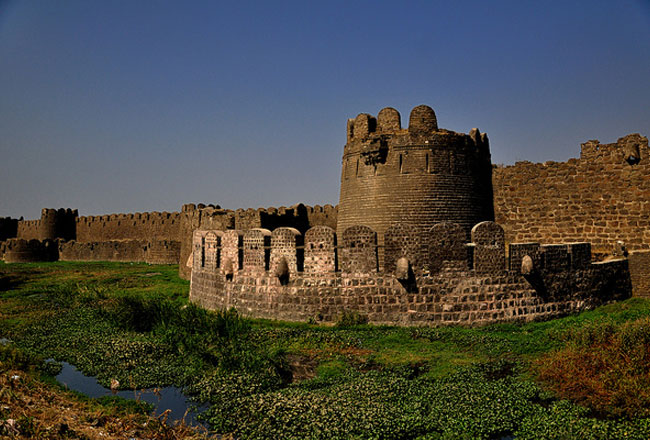
The original mud‑and‑stone fortification of Raja Gulchand was rebuilt in cut basalt by Alauddin Hasan Bahman Shah in 1347 and progressively reinforced by his successors. The plan is a rough oval of about three kilometres' circuit, with a deep moat fed in the rains by the small Bhima tributary, and fifteen great bastions arranged at irregular intervals — the largest of which, the Sherza Burj ("lion bastion") on the north‑west, mounted one of the longest cannon in fourteenth‑century India.
Inside the walls stood the royal apartments, the treasury, the great Friday Mosque (which still survives), the powder magazines, and a deep step‑well that supplied the garrison through three months of monsoon siege. Two of the original gates remain: the eastern gate, with its massive teak doors faced in iron, and the smaller postern at the south, by which Hasan's successor Muhammad Shah I is said to have ridden out at dawn to receive the embassy of Vijayanagara in 1366.
Most of the inner pavilions — the Bara Gumbad, the Mughal-period Aiwan-i-Bara Khas, the bath-house — are now in ruins, but the curtain wall is largely intact and the Sherza Burj remains the most photographed silhouette of the city.[2]
A roofed congregation, unique in India
Designed, by tradition, by Rafi‘ of Qazwin
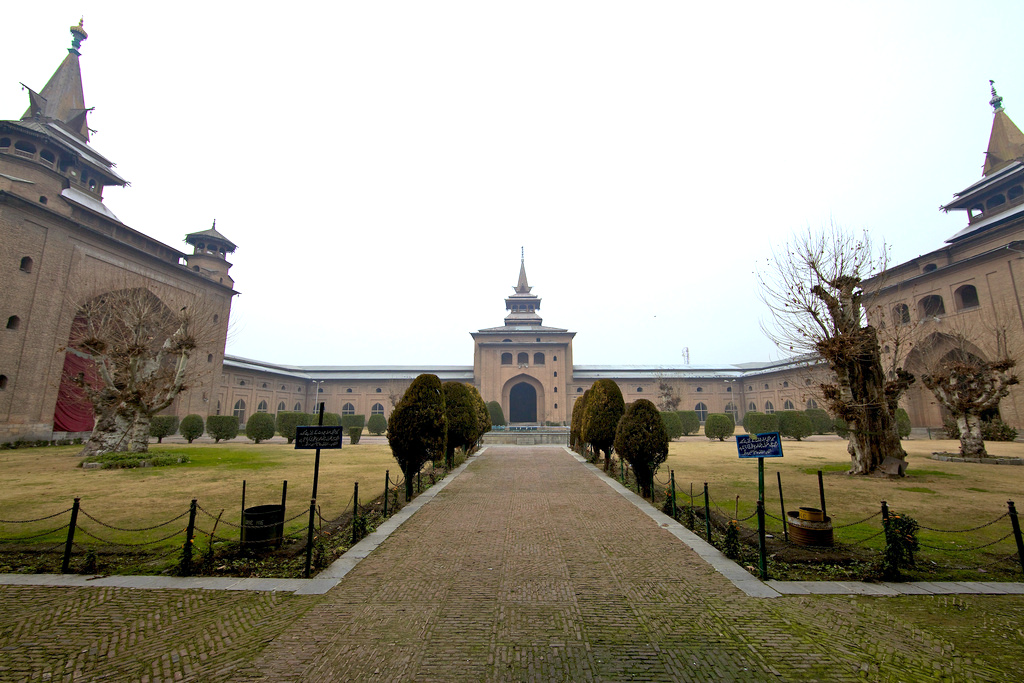
Inside the south‑western quadrant of the fort stands the Jama Masjid of Gulbarga — among the most architecturally singular mosques of the medieval Islamic world, and the only large congregational mosque in India entirely covered by a roof, with no open central courtyard.
It was completed in 1367 under Muhammad Shah I, the second Bahmani sultan, and according to a long‑standing tradition recorded by the seventeenth-century chronicler Muhammad Qasim Ferishta, it was designed by an architect named Rafi‘ ibn Shams ibn Mansur of Qazwin, who had served as far afield as Andalusia. The plan — five aisles around a closed prayer hall, with sixty‑three small domes covering the roof, four corner finials, and a single great dome above the mihrab — has often been compared to the Great Mosque of Córdoba, though the comparison is loose: there are no tile pavements, no horseshoe arches, and the piers are unfluted.
The mosque measures roughly 67 by 53 metres, with the prayer hall carried on more than 250 pointed arches springing from heavy basalt piers. There is no minaret. The interior, when shutters are closed, is one of the darkest spaces of any major Indian mosque — the architect, it seems, took quite literally the early Bahmani court's preference for the cave-like Persian chahar-taq.[2]
Seven domes for seven sultans
The royal tombs of the Gulbarga period
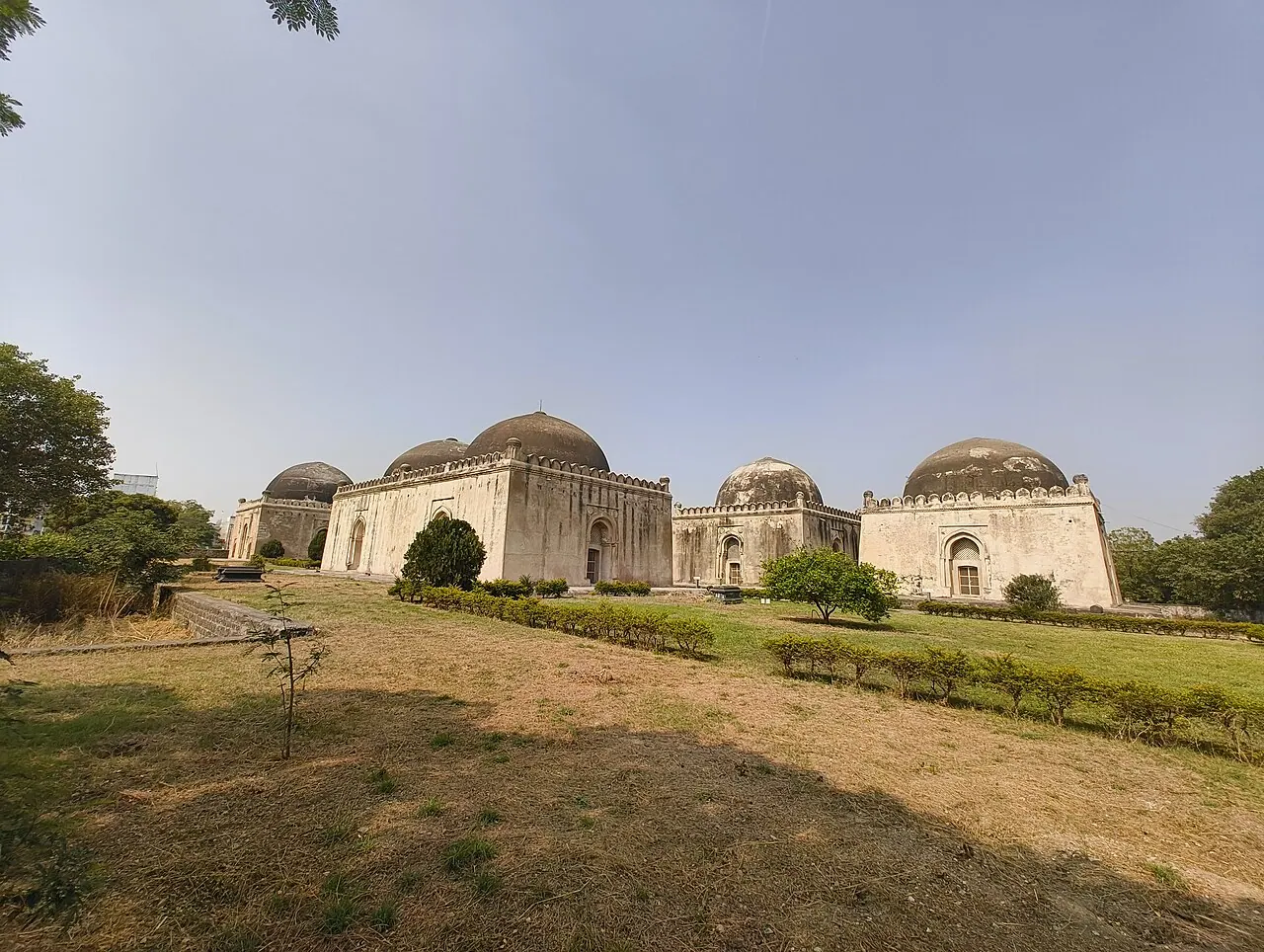
East of the city, on the road towards the dargah of Banda Nawaz, lie the Haft Gumbaz ("seven domes") — the necropolis of the early Bahmani sultans who ruled before the move to Bidar. The tombs were built in two clusters: a smaller group of low square mausolea in the late fourteenth century, and a larger, taller, more ambitious cluster culminating in the great double tomb of Tajuddin Firoz Shah and his brother Ahmad Shah Wali, completed shortly after 1422.
The earlier tombs — those of Muhammad Shah I (d. 1378), Mujahid Shah (d. 1378, assassinated), Daud Shah (d. 1378) and Muhammad Shah II (d. 1397) — are squat, austere, faced in dressed basalt with shallow battered walls and very low ribbed domes; the architectural vocabulary is still clearly that of the Tughluqs, the Bahmanis' former overlords.
The double tomb of Firoz Shah Bahmani (d. 1422) is by contrast a small palace: two great chambers under twin domes, each chamber faced internally with painted plaster of Persian arabesque, the upper drum of the dome perforated to throw shafts of light onto the cenotaphs at the noon hour. It is the architectural pivot between the Tughluqi austerity of the early Bahmanis and the Persianate exuberance that, at Bidar, would replace it.[3]
A Chishti shaikh in exile from Delhi
Khwaja Sayyid Muhammad Hussaini Gesudaraz
In 1399, fleeing the sack of Delhi by Timur, the Chishti shaikh Sayyid Muhammad Hussaini — known to all the Deccan as Khwaja Banda Nawaz Gesudaraz, "the long-haired comforter of God's servants" — arrived in Gulbarga at the personal invitation of Tajuddin Firoz Shah. He was already in his late seventies. He would live another twenty-three years, dying in Gulbarga in 1422 at the age of one hundred and one.
His twenty-three years in Gulbarga turned a frontier Bahmani capital into one of the great Sufi centres of the subcontinent. His khanqah — the lodge that became, after his death, his shrine — taught Persian and Arabic theology, the Awarif al-Ma‘arif of Suhrawardi, and the early Dakhni dialect of the bazaar; he himself wrote, late in life, a small Dakhni treatise called the Mi‘raj al-‘Ashiqin ("ascension of lovers"), the earliest substantial prose work in the language.
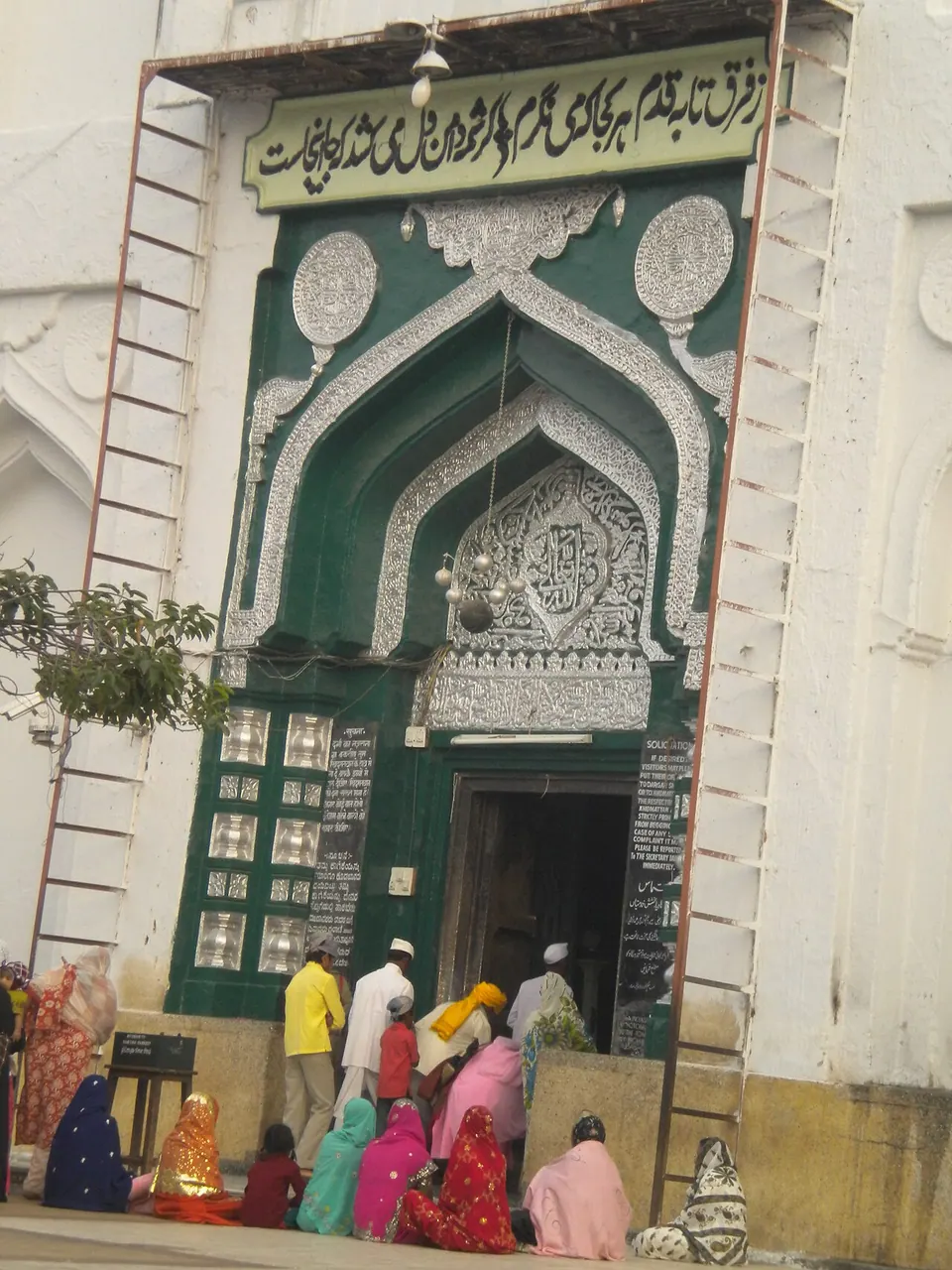
The dargah — a domed marble pavilion in a vast walled enclosure on the eastern outskirts — has been continuously expanded by every Deccan dynasty in turn: the Bahmanis built the original tomb, the Bijapuris added the gates, the Asaf Jahis re-tiled the dome in green and white, and the modern annual urs in the lunar month of Zulqada draws three to four hundred thousand pilgrims, making it the second-largest Sufi gathering in India after Ajmer.[4]
A Persianate humanism on the Deccan plateau
Astronomers, poets and a queen from Vijayanagara
Tajuddin Firoz Shah (r. 1397–1422), seventh Bahmani sultan, is by general agreement of the chroniclers the most learned of the line. He spoke Persian, Arabic, Turkish and Telugu; he composed Persian ghazals under the takhallus "Uruji"; he kept astronomers from Samarkand, calligraphers from Tabriz, physicians from Shiraz, and a small school of poets writing — uniquely for the period — in the local Dakhni vernacular.
He built an observatory at Daulatabad on the Tughluqi model, and at Gulbarga itself a domed library wing of the Friday Mosque whose ruins survive. He concluded the long war with Vijayanagara at Bankapur in 1399, and as part of the peace married a daughter of Devaraya I — a fact which the Hindu chronicles record discreetly and the Persian ones do not record at all. In 1399 he received Khwaja Banda Nawaz with court honours; in 1419, weakened by a stroke, he ceded the throne to his pious brother Ahmad and retired to a small house under the dargah, where he died in 1422.
His twin tomb, shared with Ahmad Shah Wali, is the architectural masterpiece of Bahmani Gulbarga and the closing monument of the city's first phase as a capital.[5]
When the capital walked north-east
Plague, drought and a saintly king
By the early 1420s Gulbarga was failing. A succession of bad monsoons had emptied the cisterns; a virulent epidemic — described by the chroniclers as waba, almost certainly bubonic plague — carried off thousands in 1422–24; and the granite plateau on which the city stood, with its thin red soils, had never been generous to agriculture. Ahmad Shah Wali, a disciple of Banda Nawaz, decided after long consultation with his shaikh that the capital must be moved.
The chosen site was the small fortified town of Bidar, ninety kilometres to the north-east, on a higher plateau with deeper soils and a more dependable monsoon. The transfer was made in stages between 1424 and 1429; the court, the treasury, the royal library and the great families followed in slow caravans through the Deccan winter. Gulbarga was not abandoned — it remained a Bahmani provincial seat, with its garrison, its mosque, and its dargah — but the political centre of the kingdom moved with the king.
The Haft Gumbaz, the dargah and the Friday Mosque continued to grow under royal endowment; but no Bahmani sultan was ever again buried at Gulbarga. The next twelve sultans rest at Ashtur, outside Bidar.[1]
From capital to provincial seat
Six centuries of slow continuity
After 1429 Gulbarga was a Bahmani sarkar; after 1490 it was contested between the rump Bahmani at Bidar and the rising Adil Shahis of Bijapur; in 1504 Yusuf Adil Shah seized the city and incorporated it into the Bijapur kingdom, where it remained for a century and a half. The Adil Shahi governors maintained the dargah of Banda Nawaz with great ceremony; Ibrahim Adil Shah II made the pilgrimage barefoot in 1610.
In 1656–57 Aurangzeb, then Mughal viceroy of the Deccan, reduced Bijapur's outer fortresses including Gulbarga; from 1686 the city was a Mughal subah-headquarters of the Deccan, with a Mughal kotwal in the fort. In 1724 — like Bidar, like Hyderabad — it passed peacefully into the hands of Mir Qamar-ud-Din Khan, Asaf Jah I, founder of the Hyderabad Nizamate. From that year until 1948 Gulbarga was a district of Hyderabad State; the Nizam's government endowed the dargah generously, and the seventh Nizam Mir Osman Ali Khan personally sponsored the restoration of the Jama Masjid in 1933.
At the States Reorganisation of 1956 the Kannada-speaking parts of Hyderabad State, Gulbarga among them, were transferred to the new state of Mysore (now Karnataka). The city was renamed Kalaburagi in its native form in 2014. It remains the regional capital of north-east Karnataka, with about 650,000 inhabitants and a university bearing the name of its founding sultan.
احسن آباد کے قلعے میں،
مٹی نے تخت بنایا، اور تخت نے مٹی۔
"In the citadel of Ahsanabad,
the dust made a throne — and the throne, again, dust."
— After a Dakhni quatrain attributed to Banda Nawaz, c. 1420
Gulbarga in dates
- c. 1321Gulbarga, then a Kakatiya outpost under Raja Gulchand, captured by the Delhi armies of Muhammad bin Tughluq.
- 1327Tughluq's transfer of the capital to Daulatabad; the Deccan briefly the imperial seat.
- 3 Aug 1347Hasan Gangu proclaimed sultan as Alauddin Bahman Shah; Bahmani Sultanate founded with its capital at Gulbarga, renamed Ahsanabad.
- 1358Death of Hasan Bahman Shah; succeeded by Muhammad Shah I, who organises the kingdom into four tarafs.
- 1367Jama Masjid completed within Gulbarga Fort — the only major Indian mosque without an open courtyard.[2]
- 1397Accession of Tajuddin Firoz Shah, scholar-king and patron of Persian and Dakhni letters.
- 1399Khwaja Banda Nawaz Gesudaraz arrives in Gulbarga from Delhi after Timur's invasion.
- 1422Death of Banda Nawaz at the age of 101; death of Tajuddin Firoz Shah within the same year.[4]
- 1424–1429Capital transferred from Gulbarga to Bidar by Ahmad Shah I Wali; Gulbarga becomes a provincial seat.
- 1504Yusuf Adil Shah of Bijapur seizes Gulbarga from the rump Bahmani-Barid administration.
- 1610Ibrahim Adil Shah II makes the pilgrimage to the dargah of Banda Nawaz on foot.
- 1657Aurangzeb, Mughal viceroy of the Deccan, reduces Bijapur's outer fortresses including Gulbarga.
- 1686Bijapur falls; Gulbarga incorporated into the Mughal subah of the Deccan.
- 1724Asaf Jah I assumes effective sovereignty over the Deccan; Gulbarga a district of the new Hyderabad State.
- 1933Restoration of the Jama Masjid sponsored by Mir Osman Ali Khan, the seventh Nizam.
- 17 Sept 1948Operation Polo concludes; Gulbarga accedes to the Indian Union with the rest of Hyderabad State.
- 1 Nov 1956States Reorganisation transfers Gulbarga to Mysore (now Karnataka).
- 1980Gulbarga University founded, named for Hasan Gangu's regnal title.
- 1 Nov 2014City and district officially renamed Kalaburagi in the native Kannada form.
References
- ^ ^ ^ Haroon Khan Sherwani, The Bahmanis of the Deccan: An Objective Study, Munshiram Manoharlal, New Delhi, rev. ed. 1985.
- ^ ^ ^ UNESCO Tentative List, "Monuments and Forts of the Deccan Sultanate" (includes Gulbarga Fort and Jama Masjid). ↗
- ^ George Michell & Mark Zebrowski, Architecture and Art of the Deccan Sultanates (The New Cambridge History of India I.7), Cambridge University Press, 1999.
- ^ ^ Richard M. Eaton, A Social History of the Deccan, 1300–1761: Eight Indian Lives, Cambridge University Press, 2005.
- ^ H. K. Sherwani & P. M. Joshi (eds.), History of Medieval Deccan (1295–1724), 2 vols., Government of Andhra Pradesh, Hyderabad, 1973–74.
Compiled and edited by Syed Azhar Farhan for Dakhni.org from the sources cited on this page. AI may assist research and drafting; see the editorial method, corrections log, and AI policy.
Comments
Comments are provided by Disqus. Loading them shares your visit with Disqus.