Home›Cities of the Deccan›Hyderabad
A new city by the Musi
Muhammad Quli Qutb Shah lays out the streets of Bhagnagar
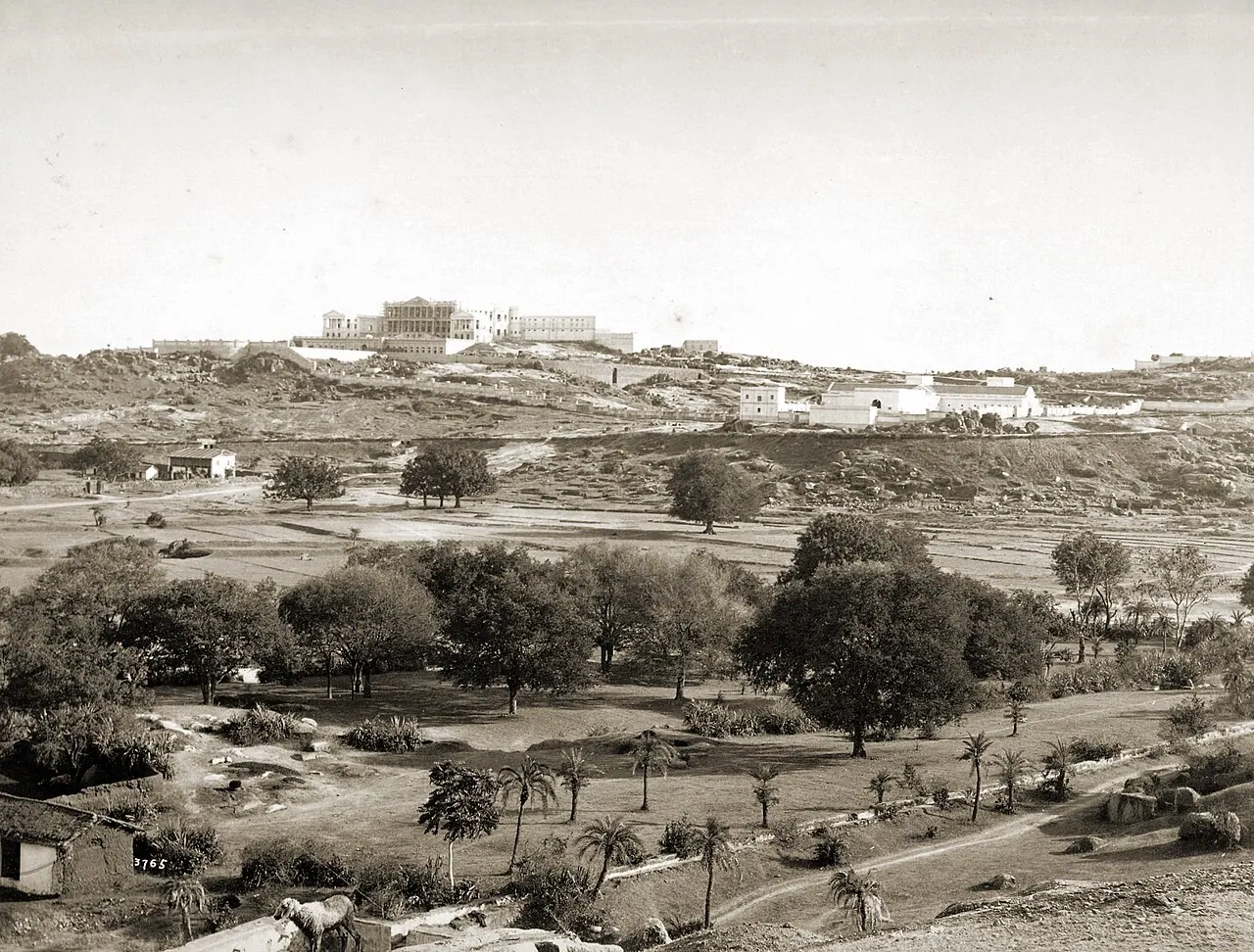
By 1590 the old Qutb Shahi seat at Golconda was overcrowded — its citadel walls were full, its wells were running thin, and the plague had passed through more than once. The fifth sultan, Muhammad Quli Qutb Shah (r. 1580–1611), decided on a new capital five miles east, on the banks of the river Musi.
Tradition records that the city was first called Bhagnagar, after Bhagmati, the consort he later married and styled Hyder Mahal — from whose name, in turn, the present Hyderabad is said to come. The geometric grid he ordered — four great avenues meeting at a central tetrapylon — was an act of urban planning unusual for its time anywhere in India.
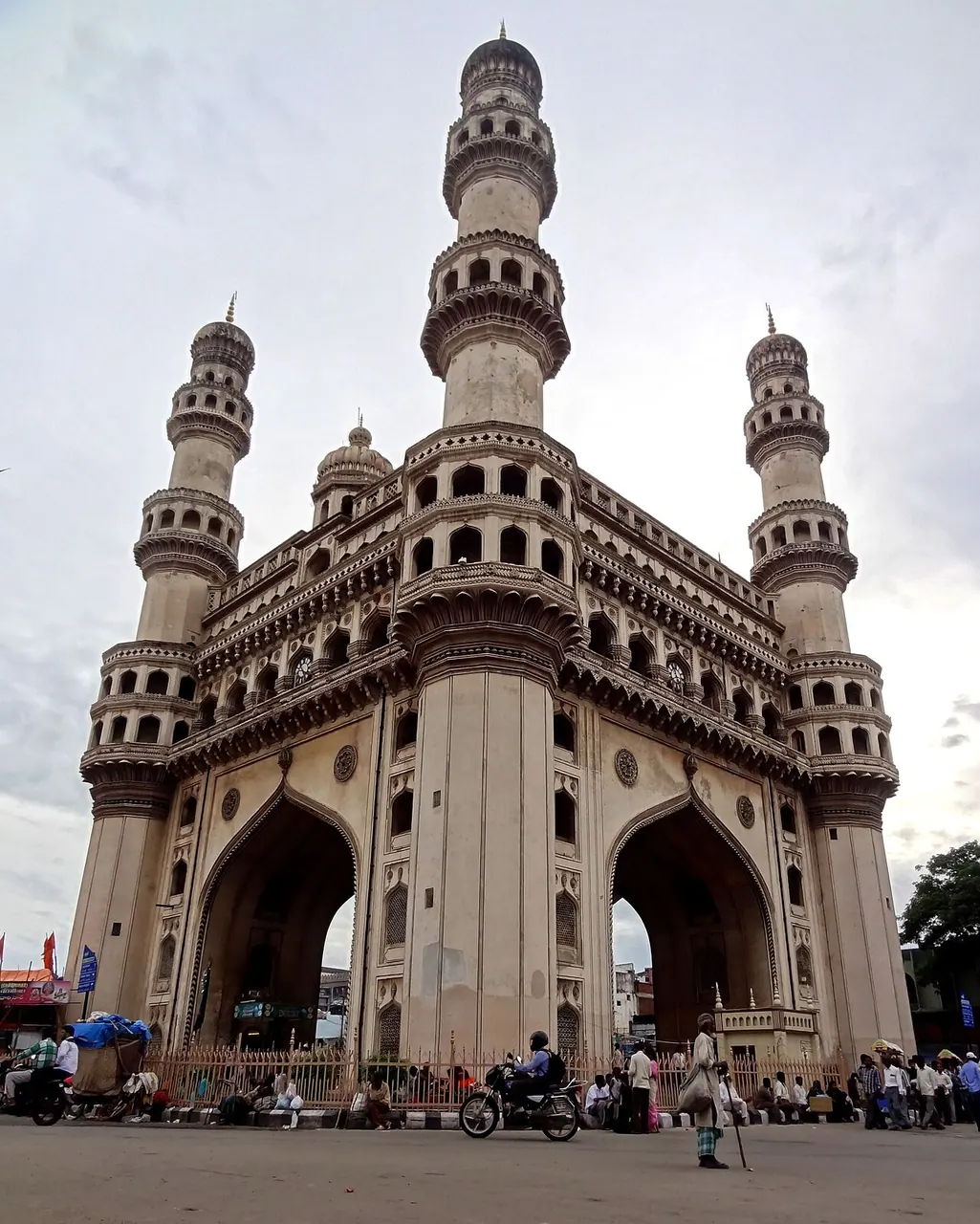
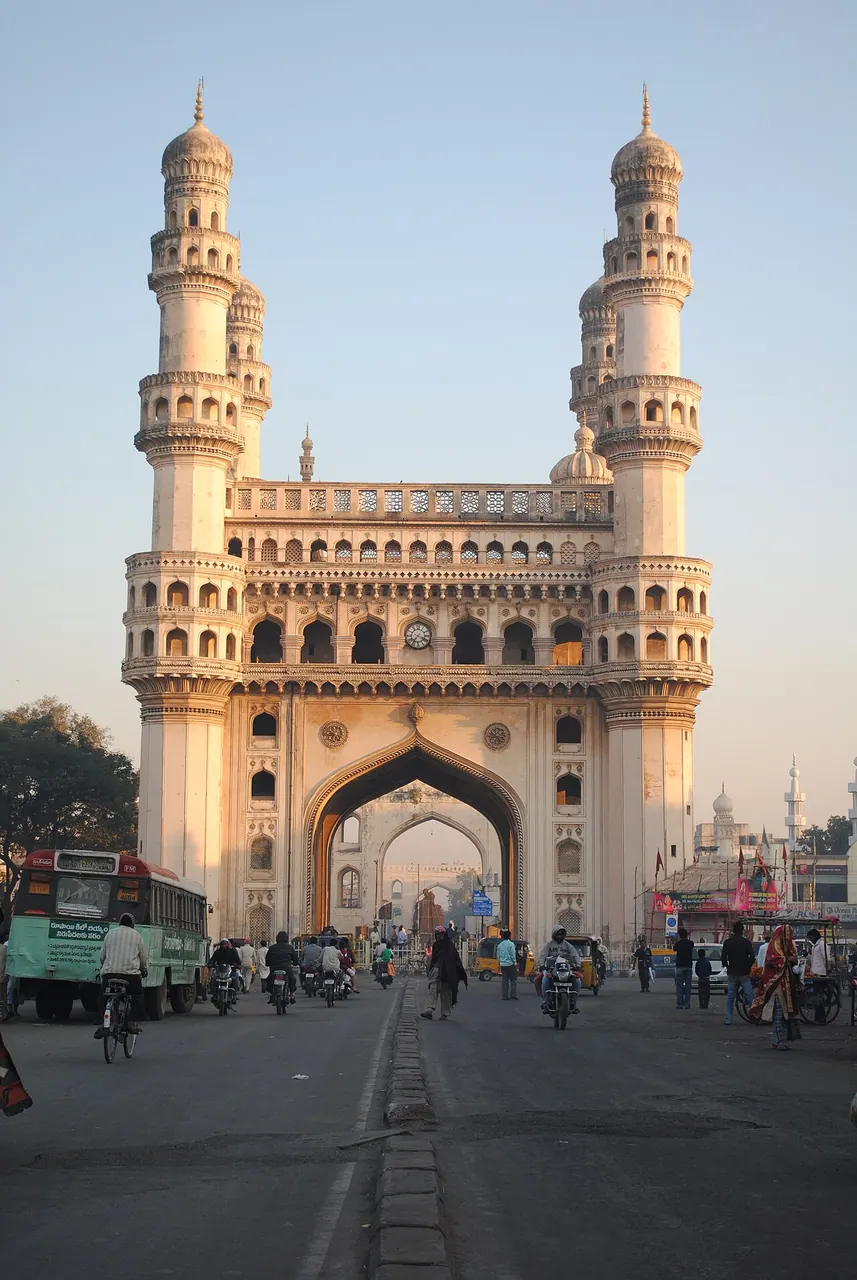
At the centre of the four roads he raised the Charminar, in 1591, in thanksgiving for the end of an epidemic. From its arches the city was measured. The Mecca Masjid would rise at its foot in 1614; the bazaars of Laad Bazaar, Pathergatti and Madina would crystallise around it. Hyderabad was a planned city, designed and dated, and that planning still shows.[1]
Four minarets, four roads
A monument that is also a town plan
The Charminar — literally four minarets — is at once an Islamic prayer hall, a triumphal arch, a public clock-tower and the cardinal point from which Hyderabad is laid out. Each side measures roughly twenty metres; each minaret rises fifty-six. The ornament is local Deccani: pointed Qutb Shahi arches, lime-stucco ornament, a discreet use of granite — sober where Lahori or Agra work would have been busy.
Mir Momin Astarabadi, the Persian-born peshwa of Muhammad Quli, is generally credited as its designer. The upper storey contains a small mosque; the lower opens onto the four streets. For two centuries it sounded the noon prayer for the entire walled city.[2,3]
The bazaars at its feet — Laad Bazaar for lacquered bangles, Pathergatti for stone, Madina for cloth — are still the working old city. They have not moved in four hundred years.
A fortress of granite and diamonds
Qutb Shahi seat from 1518 to 1591
Before Hyderabad there was Golconda — a granite hill seven kilometres west of the new city, fortified by the Kakatiyas as early as the twelfth century, captured by the Bahmanis in 1364, and made capital by Sultan Quli Qutb-ul-Mulk in 1518 when he declared the independence of his Telangana governorate. For seventy-three years the dynasty ruled from inside its three concentric walls.
Golconda's wealth was diamonds. The Kollur mines at the river Krishna, an outwork of this kingdom, produced the Koh-i-Noor, the Hope, the Regent and the Daria-i-Noor — every great Indian diamond of the European cabinet rooms. Tavernier, the seventeenth-century French jeweller, said that the city's bazaar dealt in 60,000 pearls and rough stones a day.
The fort itself is a feat of acoustic engineering — a hand-clap at the Fateh Darwaza can be heard at the Bala Hisar pavilion a kilometre uphill. It fell to Aurangzeb only in 1687, after an eight-month siege and an act of internal treachery.[4]
A garden of kings
Where the Qutb Shahis rest
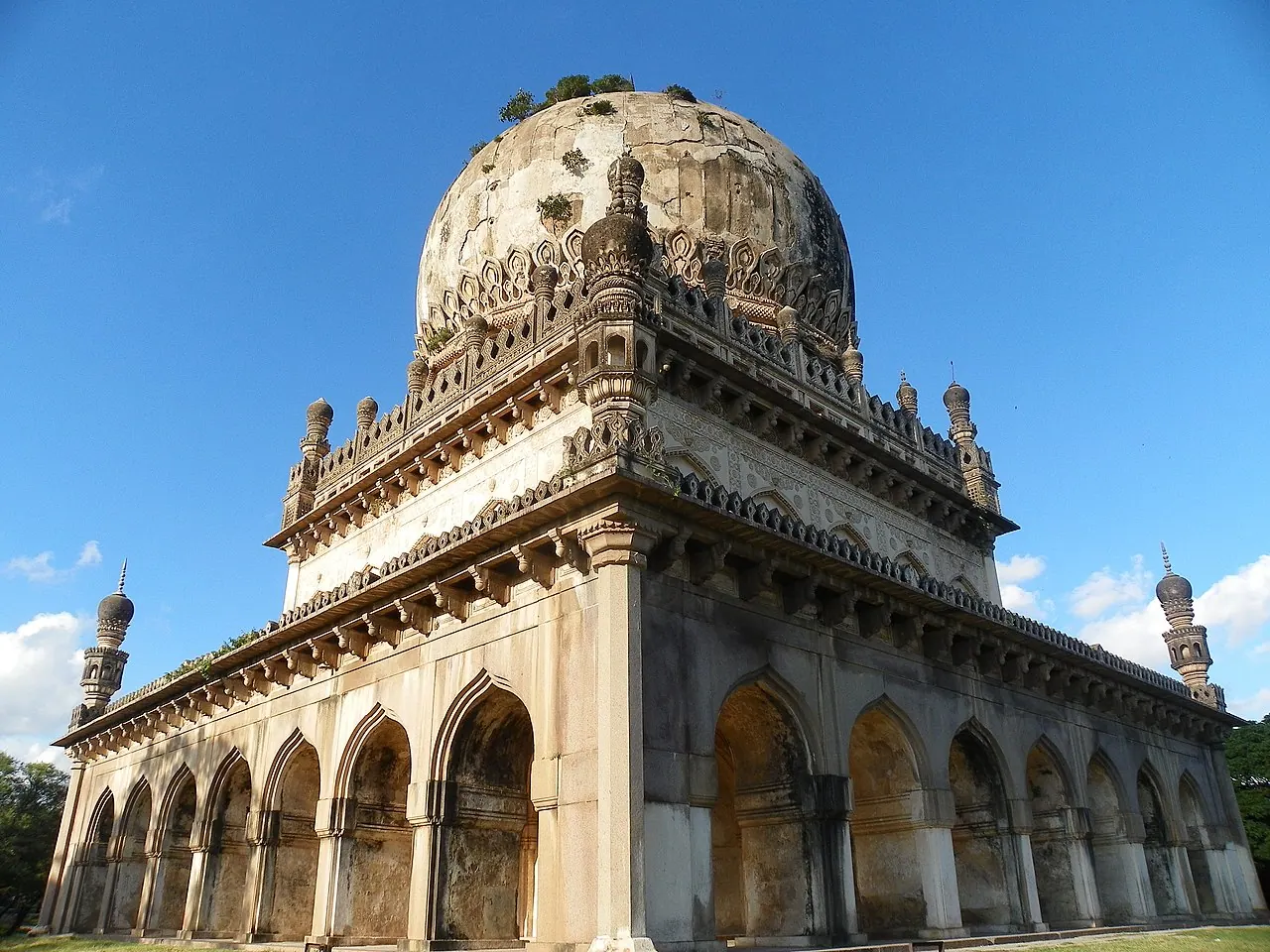
A short ride from Golconda's outer wall lies the Qutb Shahi necropolis — twenty-one domed tombs in a single walled garden, each commissioned by a reigning sultan for himself in the manner of a man planting his own cypress. They are the most complete dynastic burial ground in southern India: seven sultans, their consorts, princes, children and a master physician, all under one set of cornices.
The architecture moves visibly with the dynasty. Quli Qutb-ul-Mulk's tomb (d. 1543) is austere, almost a smaller cousin of the Bahmani style of Bidar. By the time of Muhammad Quli (d. 1612) the domes have grown, the spandrels are picked out in tile, and the inscription bands flow as comfortably in Telugu signature as in Arabic prayer.
The complex was restored between 2013 and 2024 in one of the largest single conservation projects ever undertaken in the Deccan, returning lime plaster, glazed tile and lost finials to almost every dome.[3]
Aurangzeb at the gate
Eight months, an inside man, the end of the Qutb Shahi line
In January 1687 the Mughal emperor Aurangzeb personally led an army of more than a hundred thousand against Golconda. His pretext was the refusal of the last Qutb Shahi, Abul Hasan Tana Shah (r. 1672–1687), to extradite the Hindu Brahmin minister Madanna and his brother Akkanna, the most effective administrators in the southern Deccan.
Golconda's walls held for eight months. The Mughal mines failed; assault parties were repulsed; Tana Shah's general Abdur Razzaq Lari was wounded seventy times in a single day's combat and survived. The fort fell at last only because an Afghan officer, Sarandaz Khan, opened a postern at night for a Mughal bribe.
Aurangzeb annexed the kingdom into the Mughal subah of Hyderabad, kept Tana Shah a state prisoner at Daulatabad until his death in 1699, and absorbed the Kollur mines, the Hyderabad mint and the Coromandel trade into the imperial revenue. The dynasty was over after one hundred and seventy years.[5]
A state run by seven Nizams
Court at Aurangabad, then Hyderabad — and a sovereignty that almost survived
In 1724 Mir Qamar-ud-Din Khan, a Mughal viceroy in the south styled Nizam-ul-Mulk Asaf Jah, defeated the imperial pretender Mubariz Khan at the battle of Shakar Kheda and founded what would become the longest-lived of all the Mughal successor states — a dynasty of seven Nizams that lasted until 1948.
The Nizamate was a courtly, multilingual state. Its diwans were Persians, its army officers Afghan and Arab, its revenue clerks Telugu Brahmins, its scholars Sunnis from Lucknow and Shi'a from Isfahan. Persian was the language of record until 1884; Urdu thereafter; Telugu, Marathi, Kannada were the languages of administration in the districts.
The seventh and last Nizam, Mir Osman Ali Khan, founded Osmania University (1918) — the first in India to teach in a non-English language — alongside the High Court, the State Bank, the Begumpet Aerodrome, Osmania General Hospital, the Nizam's Charitable Trust, and an early eugenics-era family-planning programme. He is also remembered for his absolute personal frugality, and a wealth that Time in 1937 put at 25% of the world's gold reserves.[6]
Falaknuma, Chowmahalla, Salar Jung
A city built in stone for a dynasty that never quite lost
Falaknuma Palace ("mirror of the sky") was built between 1884 and 1893 by Nawab Vikar-ul-Umra. Designed by an English architect in a scorpion-shaped plan, it has 220 rooms, one of the longest dining tables in the world (101 seats), and a marble Italian staircase. The sixth Nizam bought it on a whim in 1897 and used it as guest-house for visiting royalty including Edward VII and George V.
Chowmahalla ("four palaces") was the official seat of the Nizams from 1750 onward — a complex of four pavilions arranged around a long axial pool, with a Khilwat durbar hall lit by nineteen chandeliers from Belgium. Coronations were held here; the Nizam's clock has chimed without missing for two and a half centuries.
And the Salar Jung Museum, founded on the personal collection of Nawab Mir Yusuf Ali Khan Salar Jung III (1889–1949), the prime minister of the seventh Nizam, holds 1.1 million objects across thirty-eight galleries — the largest one-man art collection in the world.
Bricks from Mecca in the keystones
A mosque eight decades in the making
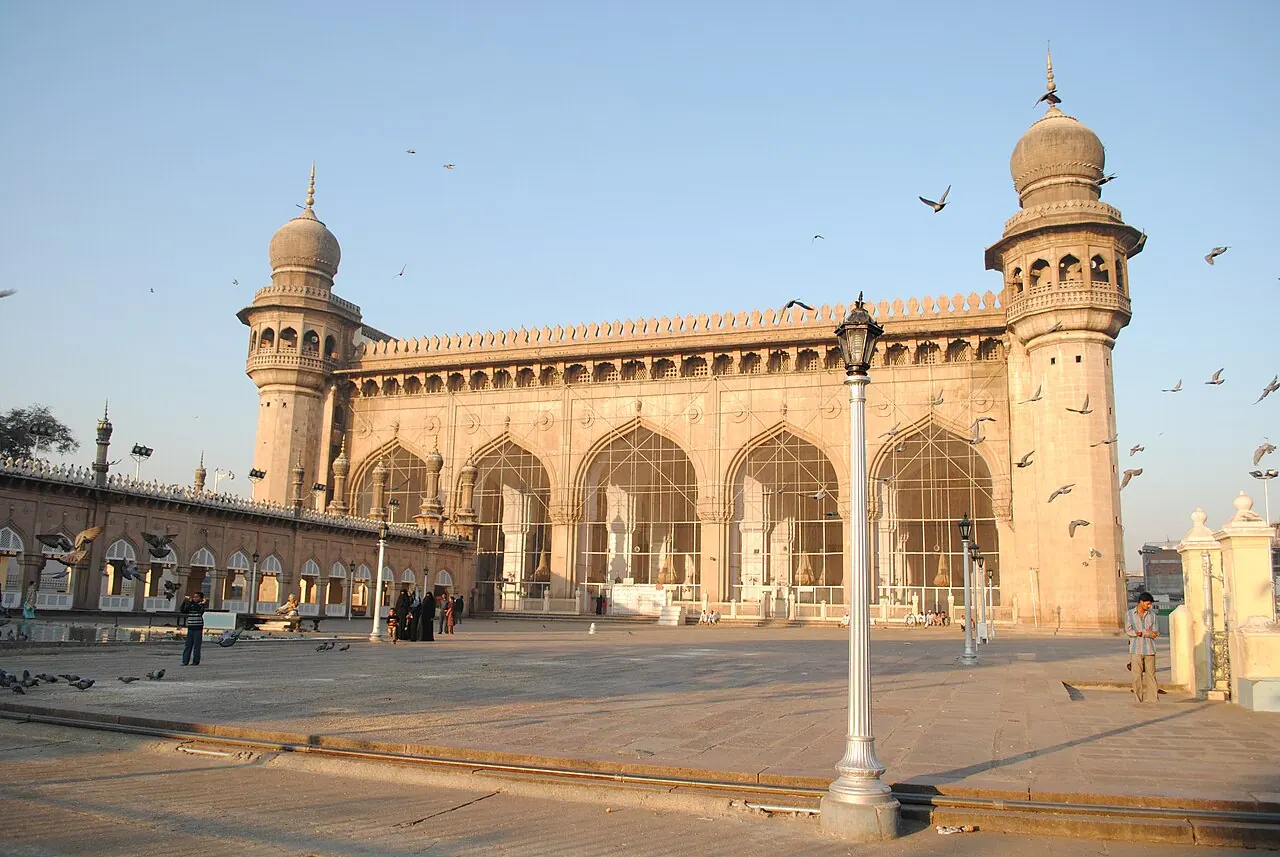
The Mecca Masjid was begun in 1614 by Muhammad Qutb Shah, continued by his nephew Abdullah Qutb Shah, and only completed in 1694 — under the new Mughal administration of the conquering Aurangzeb. Bricks made from clay specially brought from Mecca are reputed to be set into the central archway above the mihrab, giving the mosque its name.
Its prayer hall holds ten thousand worshippers; its courtyard another thirty-five thousand. Beneath an unassuming gallery on the southern wall lie the tombs of every Asaf Jahi Nizam from the second to the seventh — a quiet, almost forgotten dynastic mausoleum on the floor of a working mosque.
The original chronogram is still visible on the eastern arch: Masjid-i-Khuda, "the house of God," in fine Tughra script.
The accession of Hyderabad State
Five days that ended the longest-lived Mughal successor
At Indian independence in August 1947, the Nizam Mir Osman Ali Khan declined to accede to either Dominion. For thirteen months Hyderabad State remained a sovereign holdout, ringed by Indian territory, with its own currency, army and aspirations to United Nations observership.
On 13 September 1948 the Government of India launched a "police action" — code-named Operation Polo — across five fronts. The Hyderabad State Forces (Razakars and the Nizam's regular army together) numbered roughly 22,000 against 36,000 Indian troops. The campaign lasted one hundred and eight hours; on 17 September Major-General Syed Ahmed El Edroos surrendered the city.
The Nizam was retained as Rajpramukh (constitutional head) of the new Hyderabad State within India until 1956, when the State was trifurcated by language — Telangana to Andhra, Marathwada to Bombay, Kannada-speaking districts to Mysore. The political end did not erase the cultural continuity. The Dakhni dialect, the Hyderabadi cuisine, the qawwali at Yousufain, the durbar etiquette, the calligraphic letterhead — all of it is still here.[7]
میرا شہر حیدرآباد، چار مینار کا شہر،
جہاں مٹھاس بولی میں، اور خوشبو ہر سحر
"My city, Hyderabad — the city of four minarets,
where sweetness lives in the speech, and fragrance in every dawn."
— Anonymous Dakhni couplet, 19th century
Hyderabad in dates
- 1518Sultan Quli Qutb-ul-Mulk declares the independence of Telangana from the Bahmani Sultanate; Golconda becomes capital.
- 1591Muhammad Quli Qutb Shah founds Bhagnagar (later Hyderabad) and raises the Charminar.
- 1614Construction of the Mecca Masjid begins.
- 1687Aurangzeb takes Golconda after an eight-month siege; the Qutb Shahi dynasty ends.[5]
- 1724Mir Qamar-ud-Din wins the battle of Shakar Kheda and founds the Asaf Jahi Nizamate.[6]
- 1750Chowmahalla Palace begun under Salabat Jung; later the official seat of the Nizams.
- 1798Subsidiary alliance with the East India Company under Nizam Ali Khan; Hyderabad becomes the largest princely state of British India.
- 1803Sikandar Jah moves the cantonment north of the Husain Sagar; it is named Secunderabad after him.
- 1893Falaknuma Palace completed.
- 1908The Great Musi Flood: 15,000 dead. Sir Mokshagundam Visvesvaraya is invited to redesign the city's drainage; the Hussain Sagar bunds and Osmansagar reservoir result.
- 1918Osman Ali Khan founds Osmania University — the first Indian university to teach in a non-English language (Urdu).
- 1937Time magazine puts the seventh Nizam on its cover as the wealthiest man in the world.
- 15 Aug 1947Indian independence; Hyderabad declines to accede.
- 17 Sept 1948Operation Polo — Hyderabad State Forces surrender; the State accedes to India.[7]
- 1 Nov 1956States Reorganisation Act trifurcates Hyderabad State.
- 1967Death of Mir Osman Ali Khan, last Nizam.
- 2 June 2014Telangana State carved out of Andhra Pradesh; Hyderabad becomes its capital.
References
- ^ ^ Encyclopaedia Britannica, "Hyderabad" (the city). ↗
- ^ Archaeological Survey of India, "Charminar." ↗
- ^ ^ UNESCO Tentative List, "The Qutb Shahi Monuments of Hyderabad" (Golconda Fort, Qutb Shahi Tombs, Charminar). ↗
- ^ Encyclopaedia Britannica, "Golconda" (fortress city). ↗
- ^ ^ Richard M. Eaton, A Social History of the Deccan, 1300–1761: Eight Indian Lives, Cambridge University Press, 2005.
- ^ ^ Encyclopaedia Britannica, "Hyderabad" (the princely state, 1724–1948). ↗
- ^ ^ Omar Khalidi (ed.), Hyderabad: After the Fall, Hyderabad Historical Society, Wichita, 1988.
Compiled and edited by Syed Azhar Farhan for Dakhni.org from the sources cited on this page. AI may assist research and drafting; see the editorial method, corrections log, and AI policy.
Comments
Comments are provided by Disqus. Loading them shares your visit with Disqus.