Home›Languages of the Deccan›Urdu
اُردُو
Urdu — a seven-century making
From the soldier's tongue of the Tughluq camp to the printed page of the nineteenth century, the longest single thread in the cultural history of the Deccan.
A tongue born between the Yamuna and the camp
How Khari Boli of the Delhi countryside met the Persian of the conquerors
Urdu was not invented; it precipitated. When the Ghurid armies of Muhammad of Ghor took Delhi in 1192, they brought with them Persian — the chancery language of the eastern Islamic world — and a polyglot soldiery speaking Turkic, Pashto and the Arabic of the law. The villages around Delhi spoke Khari Boli, a western Hindi dialect descended from Shauraseni Apabhramsha. Between barracks and bazaar, a working speech emerged: Khari Boli grammar in the mouth, Persian and Arabic words in the ear, written, when it was written at all, in the Persian-Arabic script.
The thirteenth-century historian Amir Khusrau, writing at the Delhi Sultanate court, gives the language a name in passing — Hindavi, the tongue of Hind. He left a sheaf of bilingual couplets in which one line is Persian and the next Hindavi, a literary trick that only works because his courtiers understood both. The Khari Boli of his Hindavi is recognisably the ancestor of modern Urdu and Hindi alike. The split between them was, at this stage, six centuries in the future.
The word Urdu itself is much later. It derives from a Turco-Mongol root meaning a royal camp or horde (the same root as the English horde); the speech of the camp was the zaban-i-urdu-yi-mu'alla, the language of the exalted camp. Only in the eighteenth century is the phrase shortened to a single noun for the language we now know.[1]
Amir Khusrau and the literary dawn
The first poet to take the new vernacular seriously enough to write in it
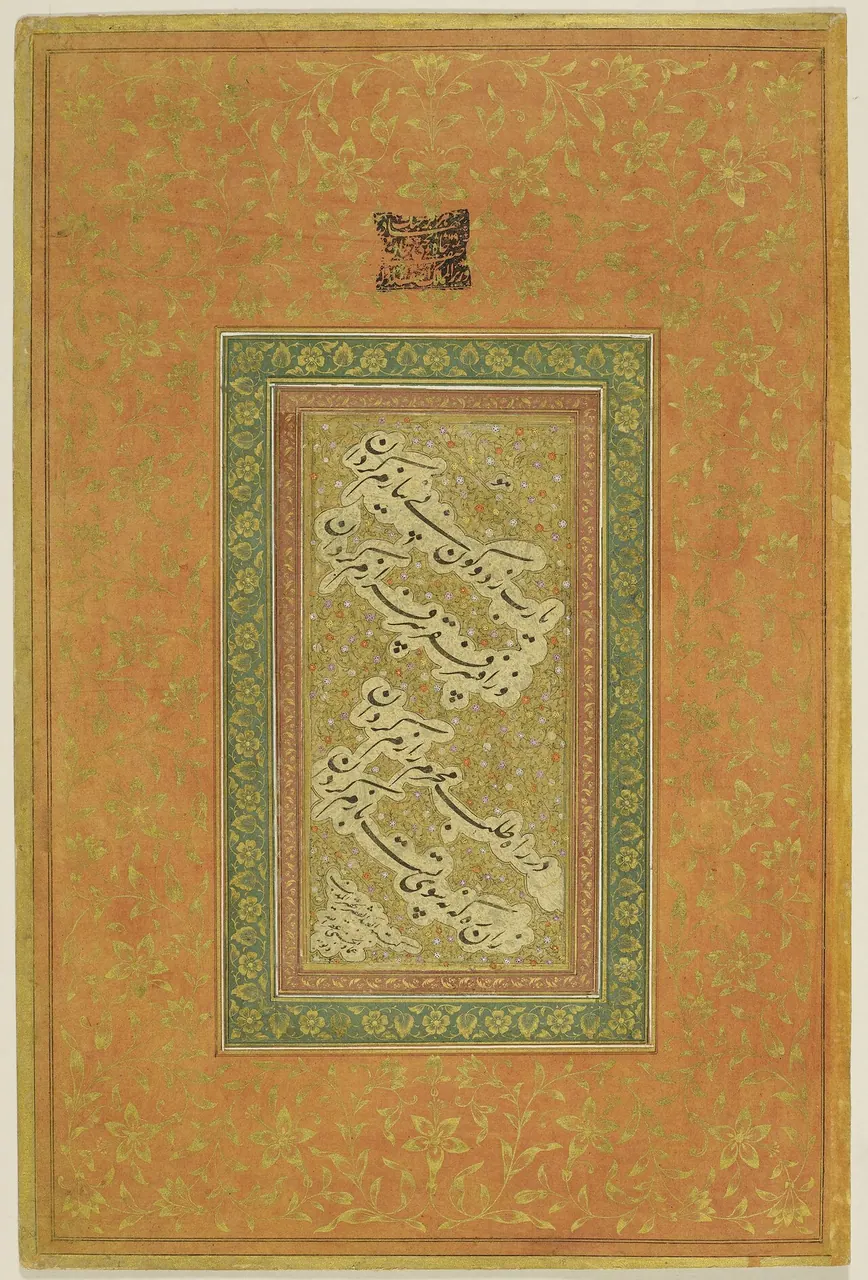
Amir Khusrau of Delhi (1253–1325) was the court poet of seven sultans and the disciple of the Chishti master Nizamuddin Auliya. He wrote five Persian masnavis and dozens of ghazal sequences for the durbar — but on his own time he composed riddles, songs, qawwali verses and short ghazals in the Hindavi of his own Delhi childhood. "Ze hal-i miskin makun taghaful, durae naina banaye batiyan," his most famous bilingual couplet, alternates a Persian first line with a Hindavi second. It is the founding verse of the long Urdu lyric tradition.
Khusrau also stands at the start of the qawwali genre and, by tradition, of the sitar and the tabla — though both attributions are folk memory rather than firm history. What is certain is that he treated the bazaar-tongue as fit for art at a time when no other court poet had thought to do so. He died in 1325 at the foot of his master's grave in Delhi. His tomb is still tended; pilgrims still recite his Hindavi verses there in their unaltered fourteenth-century form.
When Muhammad bin Tughluq, in 1327, moved the capital from Delhi to Daulatabad in the Deccan — marching tens of thousands of Delhi soldiers, scholars and merchants south on the road that would become the trunk-road of Indian history — he carried this Hindavi with him. It is the first chapter of the language's long association with the Deccan.[3]
When the language took the Deccan road
Daulatabad, Gulbarga, Bidar — three capitals in which the southern variant was born
The Hindavi-speaking population that Muhammad bin Tughluq drove south in 1327 did not all return when, eight years later, he reversed the order. Many settled. When the Bahmani sultanate broke from Delhi in 1347 and made its capital first at Daulatabad, then at Gulbarga (1347–1424), then at Bidar (1424–1538), it inherited a Persian chancery and a Hindavi-speaking populace — and the populace, by now, was three or four generations into a southern existence.
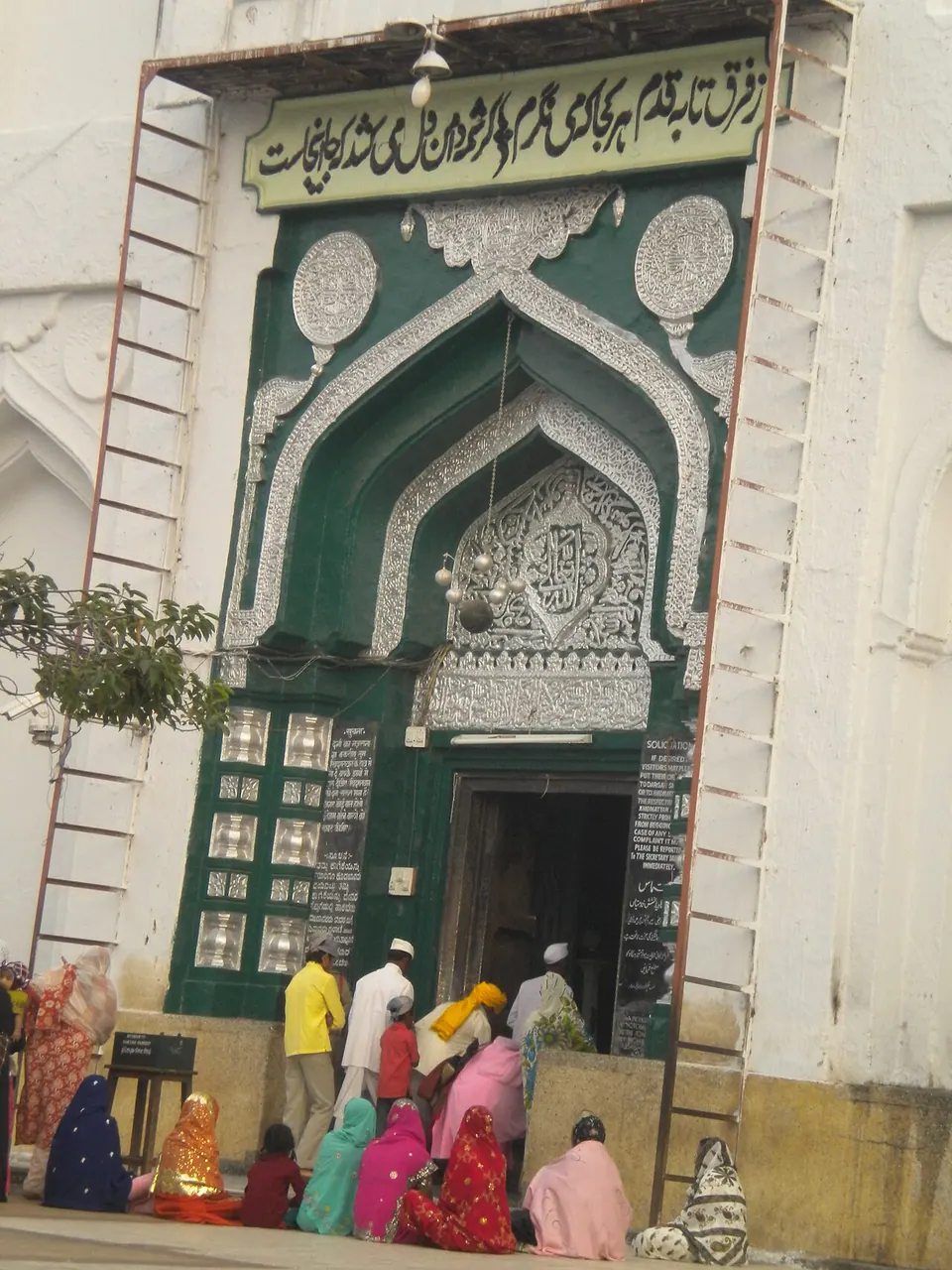
Around them lived the Telugu of the eastern plains, the Marathi of the western Deccan, the Kannada of the southern markets. The Hindavi that came down with the Tughluq column absorbed words from each. The Sufis of the new capitals, who taught and preached in the local tongue while the durbar spoke Persian, were the chief carriers. Khwaja Bandanawaz Gesudaraz (1321–1422), buried at Gulbarga, has left a few prose tracts in early Dakhni — among the earliest specimens of any north-Indian-derived vernacular committed to writing.
By the late fifteenth century, the language has a name of its own — zaban-i-dakhni, "the language of the Deccan" — and its own emerging literary register, distinguishable from the Hindavi still spoken around Delhi. The Deccan, in other words, becomes the first place where this northern vernacular acquires a proper literary identity. The story of Urdu, in any rigorous sense, begins here.[2]
When sultans wrote in the language of their people
Three sovereigns who took the vernacular into print and parchment
The Bahmani sultanate broke into five successor kingdoms after 1490. Three of them — the Qutb Shahis of Golconda, the Adil Shahis of Bijapur, and to a lesser extent the Nizam Shahis of Ahmadnagar — became the great patrons of literary Dakhni. Persian remained the language of the diwan and the firman; Dakhni became the language of the king's heart.
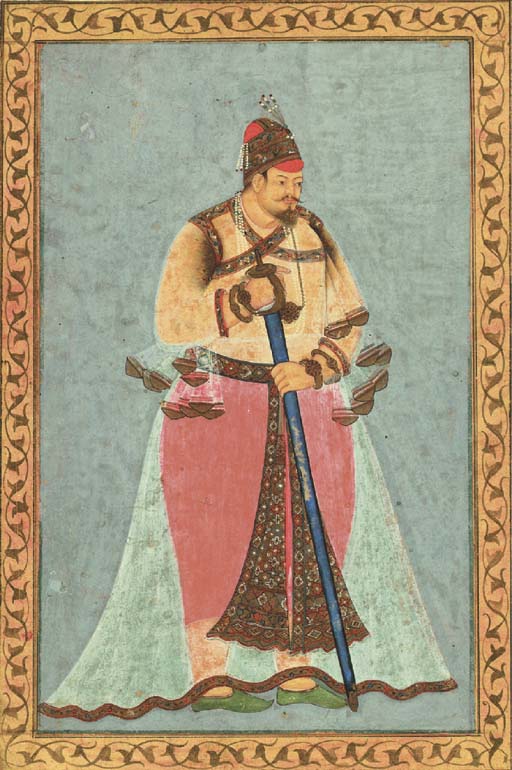
Muhammad Quli Qutb Shah (r. 1580–1611), the founder of Hyderabad, left a divan of more than 50,000 verses in Dakhni — the first sustained sovereign-poet's diwan in any South Asian vernacular. His ghazals are personal, urban, often startlingly direct; he praises his city, his beloved Bhagmati, the rains, the lamps of his durbar. Ibrahim Adil Shah II of Bijapur (r. 1580–1627) wrote in Dakhni-flavoured Hindavi the Kitab-i-Nauras — fifty-nine songs and seventeen couplets on music and aesthetics, addressed not only to Allah but to the goddess Saraswati and the Sufi master Gisu Daraz. Mulla Wajhi of Golconda, c. 1635, wrote the Sab Ras, an allegorical romance that is the first novel-like prose work in any north-Indian vernacular.
By 1650 the Deccan had a fully literate vernacular tradition — diwans, masnavis, prose romances, devotional songs, the entire technical vocabulary of love-poetry — at a moment when the Mughal North was still writing all its serious literature in Persian. The centre of gravity of Hindustani letters, against all expectation, lay in the south.[2]
A poet from Aurangabad walks into Delhi
The single visit that reshaped the literature of the Mughal capital
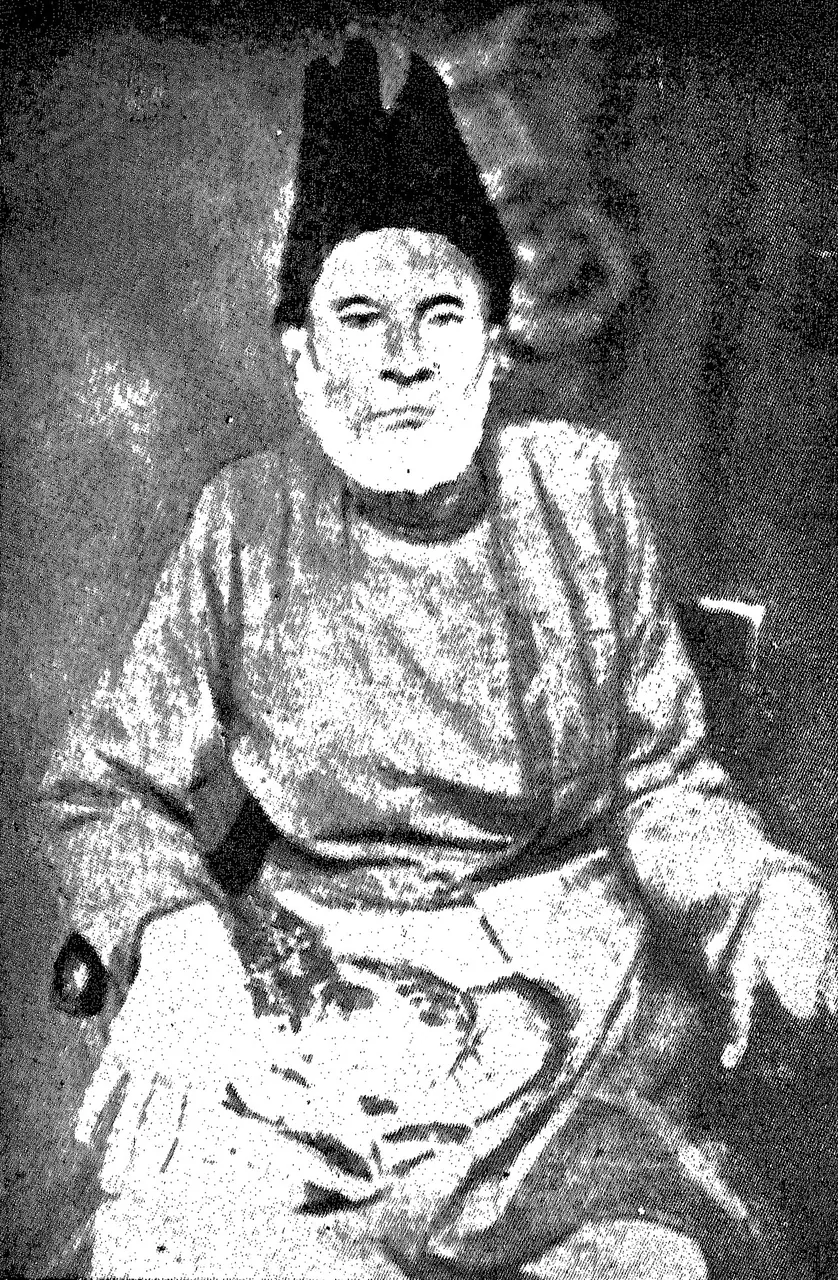
Wali Mohammed Wali — known to history as Wali Deccani or Wali Aurangabadi — was born at Aurangabad in 1667 and travelled to Delhi around the year 1700. His diwan, in the Dakhni-inflected Urdu of the south, circulated in the Mughal capital with the force of revelation. The Delhi poets of the day were still writing their ghazals in Persian; the vernacular was treated as a thing of the bazaar. Wali's collection demonstrated, in two or three readings, that the vernacular was fully equal to Persian in delicacy, range and prosodic precision.
Within a generation, the entire poetic class of Delhi was writing in what they now called Rekhta — the "mixed" tongue — and what we now simply call Urdu. Khan-i-Arzu, Hatim, Mazhar Jan-i-Janan, and after them Mir Taqi Mir and Mirza Sauda — none of these poets would have written ghazals in their own vernacular had Wali's diwan not arrived from the south. He is the hinge of the entire tradition.
Wali himself returned to the Deccan and died at Aurangabad in 1707, the year Aurangzeb died at Ahmadnagar. Two long lives, two endings on the same plateau, in the same year — and a literature, by then, ready to outlive them both. His tomb at Aurangabad was destroyed in the communal violence of 2002 and rebuilt in 2003; the diwan, copied a thousand times before printing reached India, is unaffected.[4]
The classical century of the ghazal
Mir's tears, Sauda's wit, Ghalib's philosophy — and the world that ended in 1857
The eighteenth century is the great century of the Urdu ghazal. Delhi, sacked by Nadir Shah in 1739 and by Ahmad Shah Abdali six times after that, was a city in slow ruin — but its poetic life was at its height. Mir Taqi Mir (1723–1810) wrote six full divans of an almost unbearable melancholy; Mirza Sauda (1713–1781) wrote satires sharp enough to draw blood; Mir Dard (1721–1785) wrote Sufi quatrains of stark serenity.
As Delhi declined, the centre of patronage shifted east to Lucknow, where the Nawabs of Awadh built a parallel court. The Lucknow school — Mir Anis (1803–1874), Mirza Dabeer (1803–1875) — refined the marsiya, the long elegiac poem on the martyrs of Karbala, into one of the great formal achievements of Urdu literature. Their long marsiyas, recited in Muharram, are still recited today.
And above them all stands Mirza Asadullah Khan Ghalib (1797–1869), born at Agra, settled at Delhi, who carried the ghazal as far as the form would go — into philosophy, doubt, and a self-aware modernity that startles still. Ghalib lived through the Revolt of 1857 and the destruction of the Mughal court he had served. His letters from a ravaged Delhi are the first true Urdu prose of the modern kind. He died, exhausted, in 1869. With him the classical line ends.[1]
Print, prose and a national voice
From Sir Syed's reform to Iqbal's eastern philosophy
The first Urdu printing press — at Fort William College, Calcutta — appeared in 1800; the first Urdu newspaper, Jam-i-Jahan-Numa, in 1822 at Calcutta. By 1850 there were Urdu presses at Delhi, Lucknow, Lahore, Hyderabad and Madras. The change was structural: a literature that had circulated for five centuries in scribal copies became, within a generation, a literature of editions, readerships and prose.
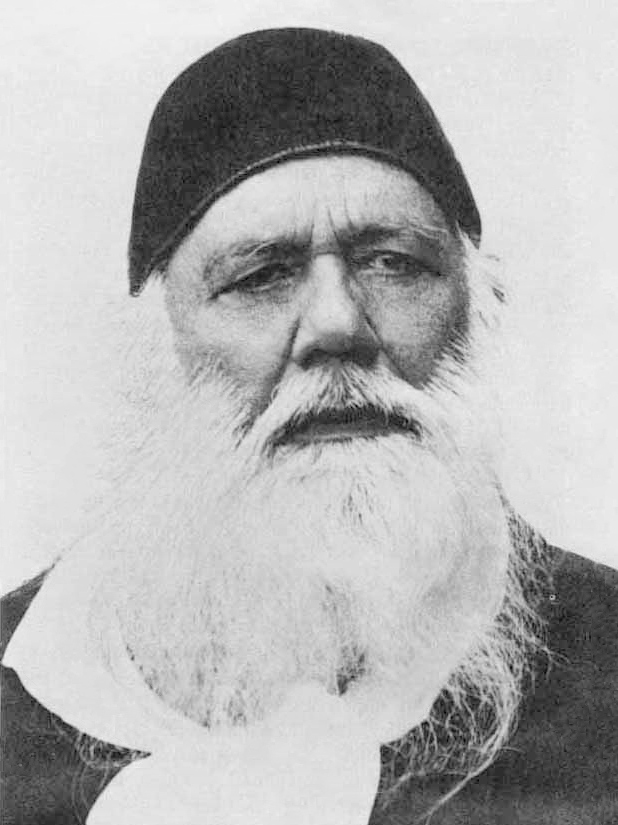
Sir Syed Ahmed Khan (1817–1898) founded the Mohammedan Anglo-Oriental College at Aligarh in 1875 and made Urdu prose the medium of a new reformist scholarship. Maulana Hali, his colleague, wrote the Musaddas (1879), a 456-stanza meditation on the rise and decline of Islam in India, in plain Urdu addressed to the public — a verse genre new to the language. Around them the Aligarh school developed the conventions of modern Urdu literary criticism, biography, history and the personal essay.
The early twentieth century gave Urdu its national philosopher in Sir Muhammad Iqbal (1877–1938) — Lahore-trained, Cambridge- and Munich-educated, who wrote in both Persian and Urdu and whose Bang-i-Dara, Bal-i-Jibreel and Zarb-i-Kalim redrew the limits of what a modern South Asian language could carry: history, theology, politics, an entire civilisation under reconstruction. Beside him stand Premchand (the bilingual founder of the modern Urdu-Hindi novel), Sajjad Zaheer and the writers of the Progressive Writers' Movement, who turned Urdu prose toward the social novel and the political short story.[5]
A language with two capitals and a southern home
How Urdu kept its Deccan continuity through the divisions of the twentieth century
The 1947 partition of British India divided Urdu into two political streams. In Pakistan it became the national language; in India it became one of twenty-two scheduled languages, with its largest concentrations of speakers in Uttar Pradesh, Bihar and — crucially — the old territories of Hyderabad State: Telangana, the Marathwada districts of Maharashtra, and the Hyderabad-Karnataka region. The aggressive Sanskritisation of Hindi after 1950 and the equally aggressive Persianisation of Urdu in Pakistan widened a literary gap that did not exist for the readers of Premchand or Ghalib.
The post-1947 Urdu of Hyderabad and the Deccan kept a different temper. The Asaf Jahi state, until 1948, had supported Urdu as its administrative language, its medium of higher education at Osmania University, and its newspaper culture (the Daily Siyasat, founded 1949, remains the largest Urdu daily in India). After integration, even as the language lost its administrative weight, it retained its everyday life — at the cinema, in the bazaar, in qawwali, in the affectionate Dakhni-Urdu mixture still heard in the old city.
The literary line, meanwhile, continued: Faiz Ahmad Faiz in Pakistan, Sahir Ludhianvi and Kaifi Azmi in India, Ahmad Faraz, Gulzar, Javed Akhtar, Munir Niazi, Parveen Shakir. The film song of Bombay carried Urdu poetry into every house in the subcontinent — including, in many cases, houses where the script was no longer read. Urdu in the twenty-first century is at once a national language of one country, a constitutional language of another, and the still-loved private speech of perhaps fifty million people who use it daily without reading it. It is, in that sense, exactly what it was in 1325: a spoken civilisation that occasionally writes itself down.[4]
ہزاروں خواہشیں ایسی کہ ہر خواہش پہ دم نکلے
بہت نکلے میرے ارمان لیکن پھر بھی کم نکلے
"A thousand longings, each enough to take a life;
many of mine have found their voice, and still it is too few."
— Mirza Ghalib · Delhi · c. 1850
From Hindavi to a Hundred Million Speakers
- c. 1100Khari Boli — a western Hindi dialect descended from Shauraseni Apabhramsha — is spoken in the villages around Delhi.
- 1192Muhammad of Ghor's victory at Tarain brings Persian, Turkic and Arabic into sustained contact with Khari Boli in the Delhi camps.[1]
- c. 1290Amir Khusrau of Delhi composes the earliest preserved Hindavi verses — bilingual ghazals alternating Persian and the vernacular.
- 1327Muhammad bin Tughluq moves the capital from Delhi to Daulatabad; tens of thousands of Hindavi speakers settle in the Deccan.[3]
- 1347Alauddin Bahman Shah founds the Bahmani sultanate at Daulatabad; Persian becomes the chancery, Hindavi the popular tongue.[3]
- d. 1422Khwaja Bandanawaz at Gulbarga leaves the earliest preserved Dakhni prose tracts — the first literary use of the southern vernacular.
- 1591Muhammad Quli Qutb Shah founds Hyderabad and writes the first sustained sovereign-poet's divan in a South Asian vernacular.[5]
- c. 1605Ibrahim Adil Shah II of Bijapur writes the Kitab-i-Nauras in Dakhni-flavoured Hindavi.
- c. 1635Mulla Wajhi of Golconda writes Sab Ras, the first prose romance in a north-Indian-derived vernacular.
- c. 1700Wali Deccani of Aurangabad arrives in Delhi with his diwan; within a generation the Mughal court abandons Persian for Rekhta/Urdu poetry.[4]
- 1739–1761Delhi sacked by Nadir Shah and Ahmad Shah Abdali; in the ruined capital, Mir Taqi Mir writes six divans of Urdu ghazals.
- 1800First Urdu printing press at Fort William College, Calcutta.
- 1822Jam-i-Jahan-Numa — the first Urdu newspaper — founded at Calcutta.
- 1857Fall of the last Mughal court; Ghalib survives the sack of Delhi and writes the first modern Urdu prose in his letters.
- 1875Sir Syed Ahmed Khan founds Mohammedan Anglo-Oriental College at Aligarh; Urdu prose becomes the medium of a new reformist literature.
- 1879Maulana Hali publishes the Musaddas, the first long verse meditation on the modern condition of Muslim India.
- 1918Osmania University founded at Hyderabad — the first modern university in India to teach the sciences in an Indian language (Urdu).
- 1930Iqbal delivers the Allahabad address; his Urdu verse begins to outline a separate Muslim polity in South Asia.
- 1936The All-India Progressive Writers' Association is founded; Urdu prose takes a decisive turn towards the social novel.
- 14 Aug 1947Pakistan declares Urdu its national language; in India it becomes one of the constitutional languages.[4]
- 17 Sept 1948Operation Polo ends Asaf Jahi rule; Osmania University's Urdu medium is phased out over the following decade.
- 1949The Daily Siyasat founded at Hyderabad — still the largest-circulation Urdu daily in India.
- 1969Ghalib centenary observed in Delhi, Karachi and Hyderabad simultaneously — perhaps the last shared Urdu literary event of the partitioned language.
- 2014Telangana State is created with Telugu as the official language and Urdu as the second official language — the constitutional recognition is the first of its kind in independent India.
- todayRoughly 70 million native speakers in India and Pakistan; about 320 million speakers worldwide if Hindi-Urdu is counted as one continuum, as linguistically it is.[1]
References
- ^ ^ ^ ^ ^ Encyclopaedia Britannica, "Urdu language." ↗
- ^ ^ ^ Richard M. Eaton, A Social History of the Deccan, 1300–1761: Eight Indian Lives, Cambridge University Press, 2005.
- ^ ^ ^ H. K. Sherwani & P. M. Joshi (eds.), History of Medieval Deccan (1295–1724), Government of Andhra Pradesh, Hyderabad, 1973–74.
- ^ ^ ^ ^ Tariq Rahman, From Hindi to Urdu: A Social and Political History, Oxford University Press, Karachi, 2011.
- ^ ^ Jamal Malik, Islam in South Asia: A Short History, Brill, Leiden, 2008.
Compiled and edited by Syed Azhar Farhan for Dakhni.org from the sources cited on this page. AI may assist research and drafting; see the editorial method, corrections log, and AI policy.
Comments
Comments are provided by Disqus. Loading them shares your visit with Disqus.