Home›Cities of the Deccan›Bijapur
Yusuf Adil Shah lifts a standard at Vijayapura
A Persian (or Ottoman) prince at the Bahmani court declares himself sultan
Bijapur — properly Vijayapura, the "city of victory" — had been a market town under the Chalukyas of Kalyana since the eleventh century, passing through the hands of the Yadavas, the Khaljis and the Tughluqs before becoming a frontier of the Bahmani sultanate in 1347. For a century and a half it was a fortified provincial capital. Then, in the 1480s, the Bahmani state began to crack along its corner provinces, and in 1490 the governor of the Bijapur sarkar, Yusuf Adil Khan, threw off allegiance and proclaimed himself sultan.
Yusuf's origin remains the most romantic problem in Deccan biography. Bijapuri court tradition makes him the son of the Ottoman sultan Murad II, smuggled out of Constantinople as an infant after the disputed succession of 1451 and sold (under Persian protection) to a Bahmani slaver. Modern historians prefer a humbler Persian merchant origin in Sava. What is undisputed is that he was a Shi'a, a poet, an accomplished horseman, and that his proclamation in 1490 created the longest-lived of the five Deccan successor sultanates.
He laid out the new capital on a plan that survives almost intact. Two concentric circuits of stone — the inner Arkilla (citadel) of half a kilometre, the outer city wall of nearly ten — enclosed a city of palaces, mosques, gardens, ninety-six bastions and five great gates. The black-basalt walls, ten metres thick at the base, can still be walked from end to end.[1]
Palaces inside the inner ring
Gagan Mahal, Anand Mahal, Sat Manzil, Asar Mahal — a court of black basalt
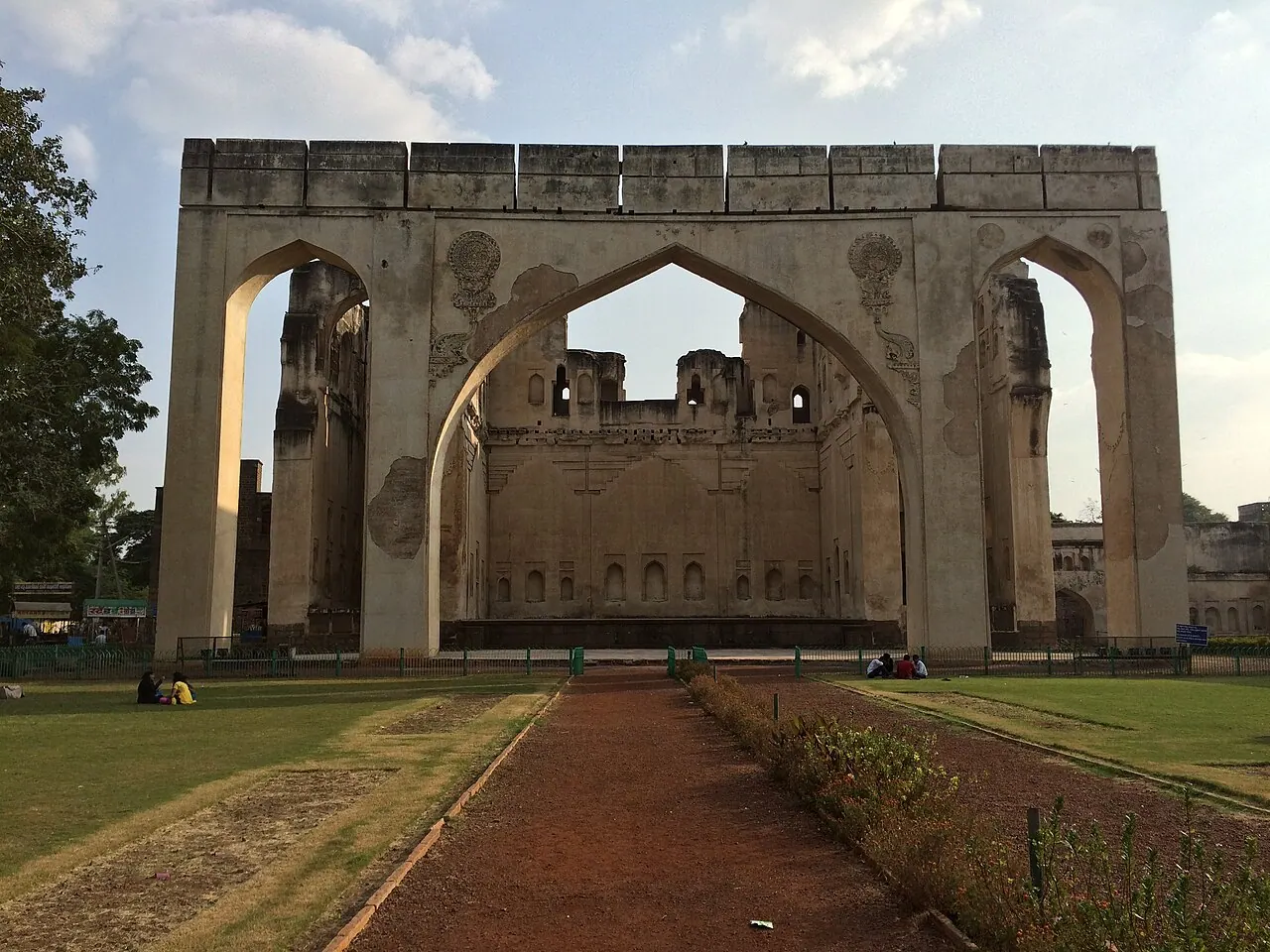
The Arkilla, the inner citadel, was the working heart of the Adil Shahi state. Within its half-kilometre wall stood the principal palaces and the durbar — built between 1561 and 1646 by four successive sultans, and almost all faced in the same hard black basalt that gives the city its sober, almost northern, character.
The Gagan Mahal ("Heaven Palace"), raised by Ali Adil Shah I in 1561, was the public audience hall: a single great arch some twenty metres across, behind which the sultan's throne stood elevated above the assembly. The Anand Mahal nearby was a private court for the queens. The Sat Manzil ("seven-storey palace") of Ibrahim II rose, when complete, to seven floors of receding pavilions; only five survive. And the Asar Mahal, built by Muhammad Adil Shah in 1646 and originally a hall of justice, was later set apart to house two hairs of the Prophet Muhammad's beard, brought from Bijapur's Persian and Arab embassies — a relic still kept there today.
Around the palaces clustered the sultan's stables, the elephant lines, the Naubat Khana and the Mehtar Mahal — that last a small but extravagantly carved gateway whose brackets and oriels owe nothing to Persia and everything to the Hindu architecture of Vijayanagara. The Adil Shahis were proudly hybrid in their masonry, even when they were warring with their hybrid neighbours.[2]
A mosque of open prayer
Ali Adil Shah I builds the largest mosque of the Deccan
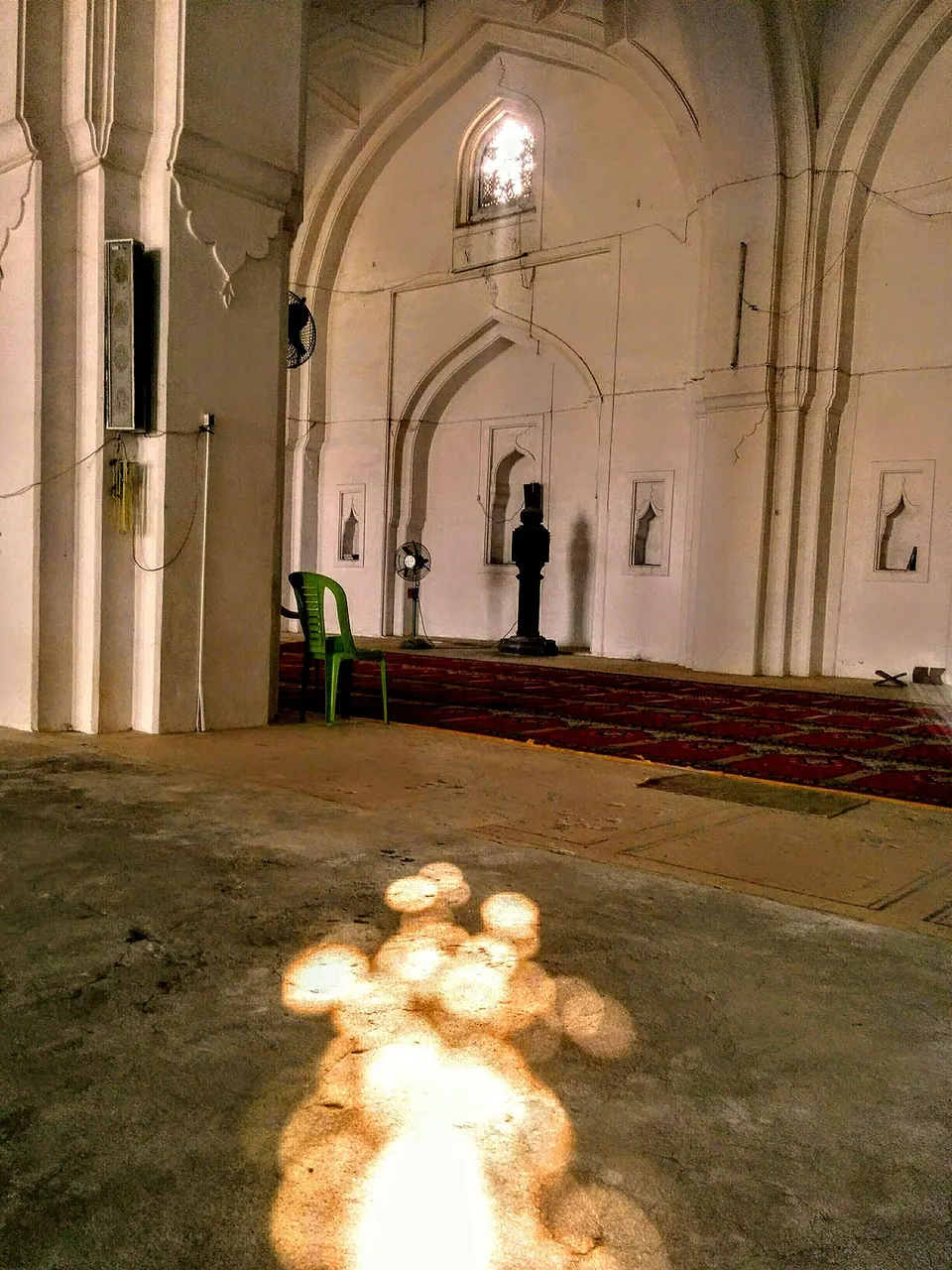
Begun by Ali Adil Shah I in 1576, the year after his triumphant return from the Battle of Talikota, the Jami Masjid is the largest congregational mosque in the Deccan and one of the largest in southern India — a court of 10,800 square metres covered by thirty-six bays of segmental vaulting, each carrying a small hemispherical dome above. The qibla wall is unbroken; the mihrab is faced with painted stucco of fine Persian floral arabesque; the prayer floor is divided by black calligraphy into 2,250 individual musallas.
The mosque is famously unfinished. Ali Adil Shah died in 1580 before the great gateway and the four corner minarets had risen above the wall-line; his successor Ibrahim II left them to his successor; the Mughal sack of 1686 finished the question. The result is austere — almost reductive — and gives the building its unmistakable air of seriousness. The Aurangzeb-era renovation added a calligraphic floor of Quranic verse painted in lapis blue, much of which survives.
It remains a working mosque. Friday prayers still gather two thousand worshippers under the original vaulting; the older men of the city's Bagayat quarter bring their grandsons here for the dawn salat in Ramazan.[3]
The Jagat Guru of the Deccan
Ibrahim Adil Shah II — poet, musician, and his own architect
Of the nine Adil Shahi sultans, none was so peculiar — or so beloved — as Ibrahim Adil Shah II (r. 1580–1627). A child of nine when he ascended the throne under regents, he came into his own at twenty and ruled for forty-seven years. He was a serious musician — an accomplished veena player who took the title Jagat Guru, "world-teacher," and addressed his book of songs first to the goddess Saraswati, only afterwards to the Prophet. The book, the Kitab-i-Nauras ("Book of Nine Sentiments"), is the great surviving treatise of Dakhni musicology, and the only major Indian book in any language entirely on the nine ragas as ethical-aesthetic states.
His court was the most plural of any in the Deccan. The poet Zuhuri came from Khurasan; the calligrapher Khalilullah from Shiraz; the painter Farrukh Beg, formerly of the Mughal atelier, settled in Bijapur and produced for him a series of sultan-portraits that survive as the masterpieces of Deccan painting. The Hindu Saraswat Brahmins of Goa held high office; the Marathi-speaking peasantry filled the army; and Telugu and Kannada were as readily heard at court as Persian.
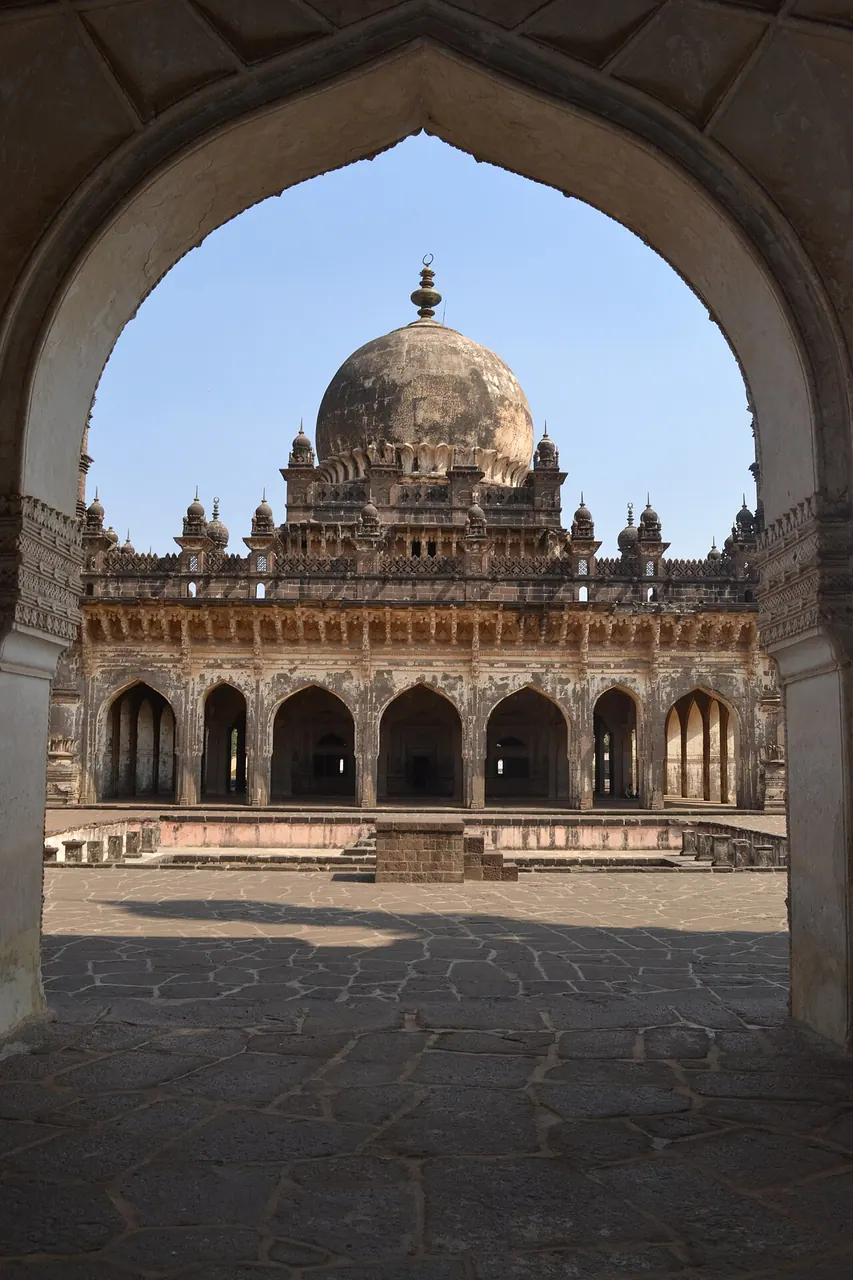
His tomb-and-mosque, the Ibrahim Rauza, was begun by him in 1620 as a mausoleum for his queen Taj Sultana and completed posthumously around 1626. It stands in a single charbagh garden west of the city wall. The two buildings face each other across a long water-channel, their bulbous black domes rising on lacelike stucco pedestals; every surface is carved with calligraphy in floral relief, every cornice with hanging stalactites of stucco. It has been called the prototype, in plan and refinement, of the Taj Mahal — which postdates it by roughly twenty years.[4]
A whisper that echoes seven times
Muhammad Adil Shah builds the second-largest unsupported dome on earth
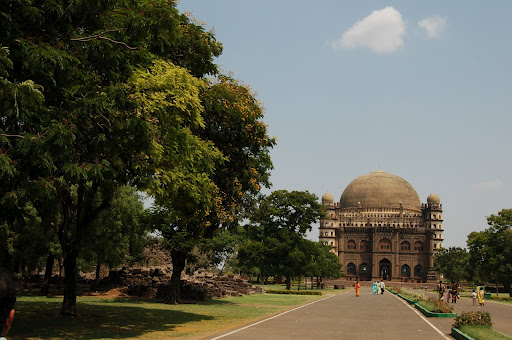
The Gol Gumbaz ("round dome") is the tomb of Muhammad Adil Shah (r. 1627–1656), the seventh sultan of the line, and the most ambitious single act of construction undertaken in the Deccan after the Charminar. It was begun in the 1620s and completed, in nearly the year of the sultan's death, in 1656. The architect was Yaqut of Dabul, working under the master-builder Malik Sandal.
The plan is a cube some forty-seven metres on each side, surmounted by a single hemispherical dome, also forty-four metres in interior diameter — for centuries the second-largest unsupported masonry dome in the world, exceeded only by the Pantheon in Rome (and surpassed only by the Florence cathedral if one counts ribbed construction). At the four corners stand seven-storey octagonal minarets, each with its own internal staircase. The walls are six metres thick at the base. The dome was raised on intersecting squinch-arches that transfer the weight outward to those four corner masses — a structural solution the Adil Shahis had been refining since Ali I's mausoleum a century before.
Around the inside of the dome at base level runs the celebrated Whispering Gallery: a balcony three feet wide, encircling the entire interior at thirty metres above the floor. The acoustic geometry is so precise that a word spoken at any point on the gallery can be heard with full clarity at the diametrically opposite point — and is heard, by interference, seven distinct times. It was a deliberate architectural conceit: Muhammad Adil Shah is said to have wanted the prayers said over his coffin to repeat without end. They do.[3]
Nine sultans, two centuries
The longest of the five Deccan successor states
The Adil Shahis were, by a clear measure, the most successful of the post-Bahmani dynasties. They outlasted the Nizam Shahis of Ahmadnagar by nearly a century, the Imad Shahis of Berar by almost two; they incorporated Bidar and the Barid Shahis into their own state in 1619; and at their height, under Muhammad Adil Shah, they ruled from the Konkan coast at Karwar to the Krishna river and from the Sahyadri to the modern boundary of Andhra Pradesh.
Their religious history was unusually mobile. Yusuf I, an Iranian, made the state officially Shi'a — the only major South Asian sultanate so to declare itself. Ibrahim I, a generation later, switched it back to Sunni rite under pressure from his Deccan nobility, which he then balanced by drawing the Marathas, the Saraswat Brahmins and the Habshi Africans into high office. Ibrahim II famously prayed in his own way, addressing songs to Saraswati and the Prophet in alternation. The Bijapuri court was, more than any in seventeenth-century India, a multi-faith state.
That plurality is what gave the dynasty its astonishing artistic output — Deccan miniature painting at its zenith under Farrukh Beg and Mir Hashim, Dakhni poetry at its zenith under Nusrati and Mulla Wajhi, the Gol Gumbaz and the Ibrahim Rauza, the Jami Masjid and the great basalt walls. Six of the nine sultans were poets in their own right; three were musicians; one, Muhammad, was the most ambitious patron of architecture South Asia produced between Akbar and Shah Jahan.[1]
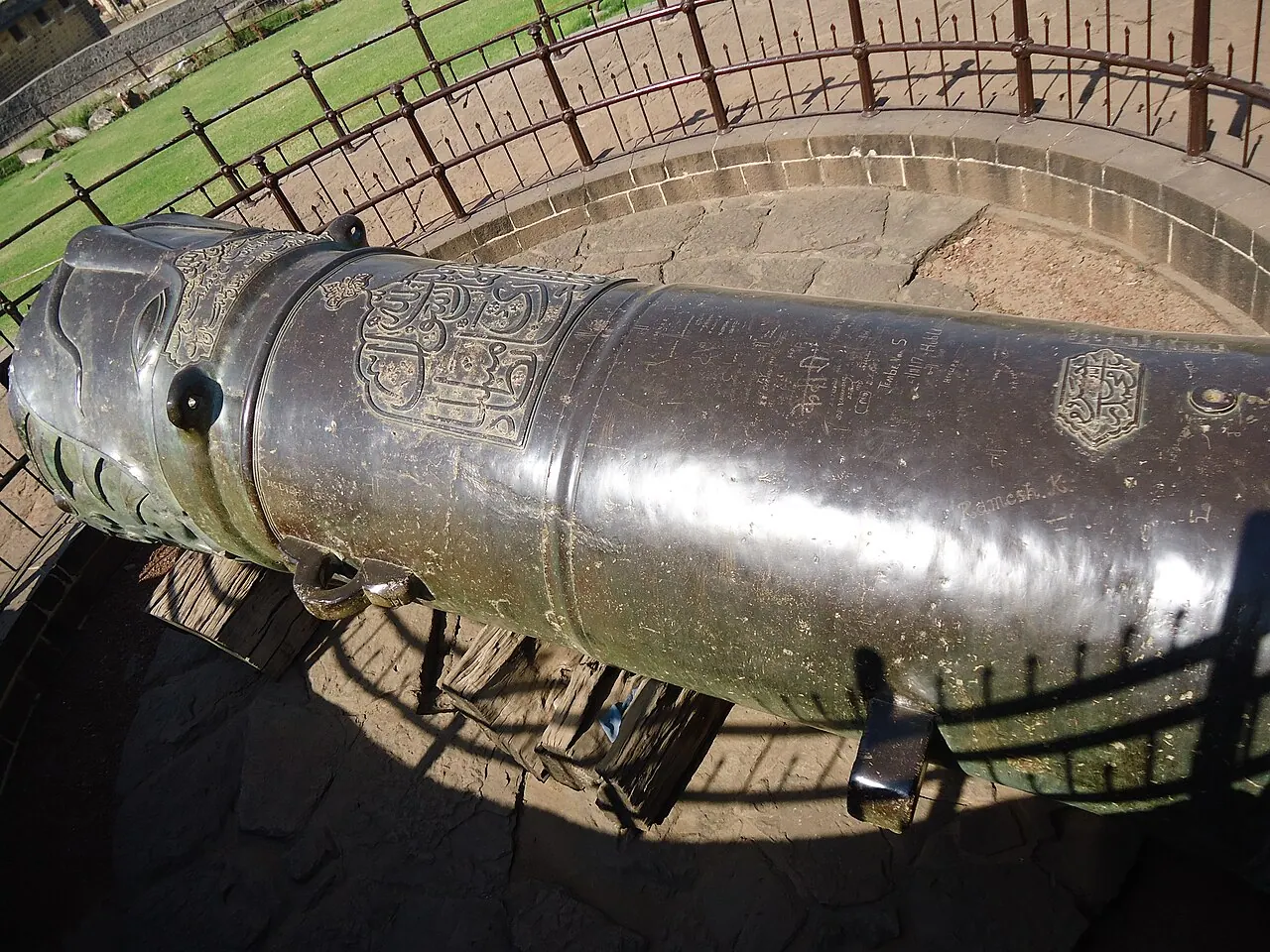
The Lord of the Battlefield
A 55-tonne bronze gun on the Sherza burj
Cast in 1549 at the foundry of Ahmadnagar by the master-gunner Muhammad bin Husain Rumi, the cannon known as Malik-e-Maidan ("Lord of the Battlefield") is the largest medieval bronze cannon ever made. The barrel is 4.45 metres long, the muzzle bore 1.5 metres across, the total weight some fifty-five tonnes. The lion-mouth at the muzzle is decorated with relief, and the touch-hole carries a Persian inscription giving the date of casting, the maker's name, and a short prayer.
The gun was carried to Bijapur after the Battle of Talikota in 1565, when the four Deccan sultanates jointly defeated and dismembered the Vijayanagara empire; ten elephants and four hundred bullocks dragged it the four hundred kilometres back. It was hauled up onto the Sherza Burj ("lion's gate bastion") of the city wall, where it stands to this day on a stone platform — too large, evidently, for any other use. Tradition holds that it was fired only once after its arrival, on the orders of Ibrahim II, and that the discharge cracked the bastion below.
The Malik-e-Maidan was one of more than fifty heavy bronze guns the Adil Shahis cast or captured in the sixteenth century; the city's walls still hold a dozen of them, including the eight-metre Lamchari on the Lamcheri burj and the Aila Burj twins. They are the most complete surviving battery of pre-modern Indian artillery.[5]
Aurangzeb at the walls
A sixteen-month investment that ended the dynasty
By 1685 the Adil Shahi state had been bleeding from two decades of Maratha pressure under Shivaji and his son Sambhaji, and by the long-running Mughal threat from the north. The eighth sultan, Ali Adil Shah II, had died in 1672 leaving as his only successor a four-year-old child, Sikandar Adil Shah, in whose name a faction of the nobility ruled — uneasily, then disastrously. The emperor Aurangzeb, who had come south himself in 1681 with the express object of finishing the Deccan sultanates, opened his investment of Bijapur in March 1685.
The walls held. The Adil Shahis had built well; the Malik-e-Maidan and her sisters were still serviceable; Sikandar's general Sharza Khan made fierce sallies. But the country round about had been stripped of its grain, the Mughal horse cordoned every road, and within the city plague broke out among the besieged garrison. After sixteen months the gate was opened on terms — 12 September 1686. Sikandar Adil Shah, eighteen years old, walked out in chains of gold and was conducted to Aurangzeb's tent. He spent the rest of his life — twenty-six years — in custody at Daulatabad. He is buried there.
The Mughals incorporated the territory into the new Subah of Bijapur, with the city as its capital. Within fifty years that authority had collapsed; the Marathas held the country between 1724 and 1818; the British took it after the Third Anglo-Maratha War. Bijapur was a district of the Bombay Presidency from 1818, of Mysore from 1956, and of Karnataka thereafter. The city was officially renamed Vijayapura in 2014 — a return, after eight centuries, to its original Chalukya name.[4]
گول گنبد کے نیچے، ہر سرگوشی سات بار،
پر شاہِ عادل کا نام، صرف ایک بار
"Beneath the Gol Gumbaz a whisper repeats seven times,
but the name of Adil Shah comes only once."
— After Nusrati, court poet of Ali Adil Shah II
Bijapur in dates
- c. 1080Vijayapura first appears in Chalukyan inscriptions as a market town in the western Deccan.
- 1294Captured by Alauddin Khalji in his great Deccan raid.
- 1347Incorporated into the new Bahmani sultanate of Hasan Bahman Shah.
- 1481Yusuf Adil Khan appointed Bahmani governor of the Bijapur sarkar.
- 1490Yusuf Adil Khan declares independence and founds the Adil Shahi dynasty.
- 1510Death of Yusuf I; succession of Ismail Adil Shah.
- 1549Casting of the Malik-e-Maidan cannon at Ahmadnagar by Muhammad bin Husain Rumi.
- 1561Ali Adil Shah I builds the Gagan Mahal as the audience hall of the Arkilla.
- 1565Battle of Talikota: the four Deccan sultanates defeat Vijayanagara; Bijapur takes the Malik-e-Maidan as part of its share.[5]
- 1576Ali Adil Shah I begins the Jami Masjid — the largest mosque in the Deccan.
- 1580Ibrahim Adil Shah II ascends the throne, aged nine.
- c. 1600Ibrahim II composes the Kitab-i-Nauras, treatise on the nine ragas, in early Dakhni.
- 1619Bijapur annexes the Barid Shahi sultanate of Bidar; Ibrahim II adds the Bidri-producing region to his domain.
- c. 1626Completion of the Ibrahim Rauza, a generation before the Taj Mahal.
- 1656Completion of the Gol Gumbaz; death of Muhammad Adil Shah; succession of Ali Adil Shah II.
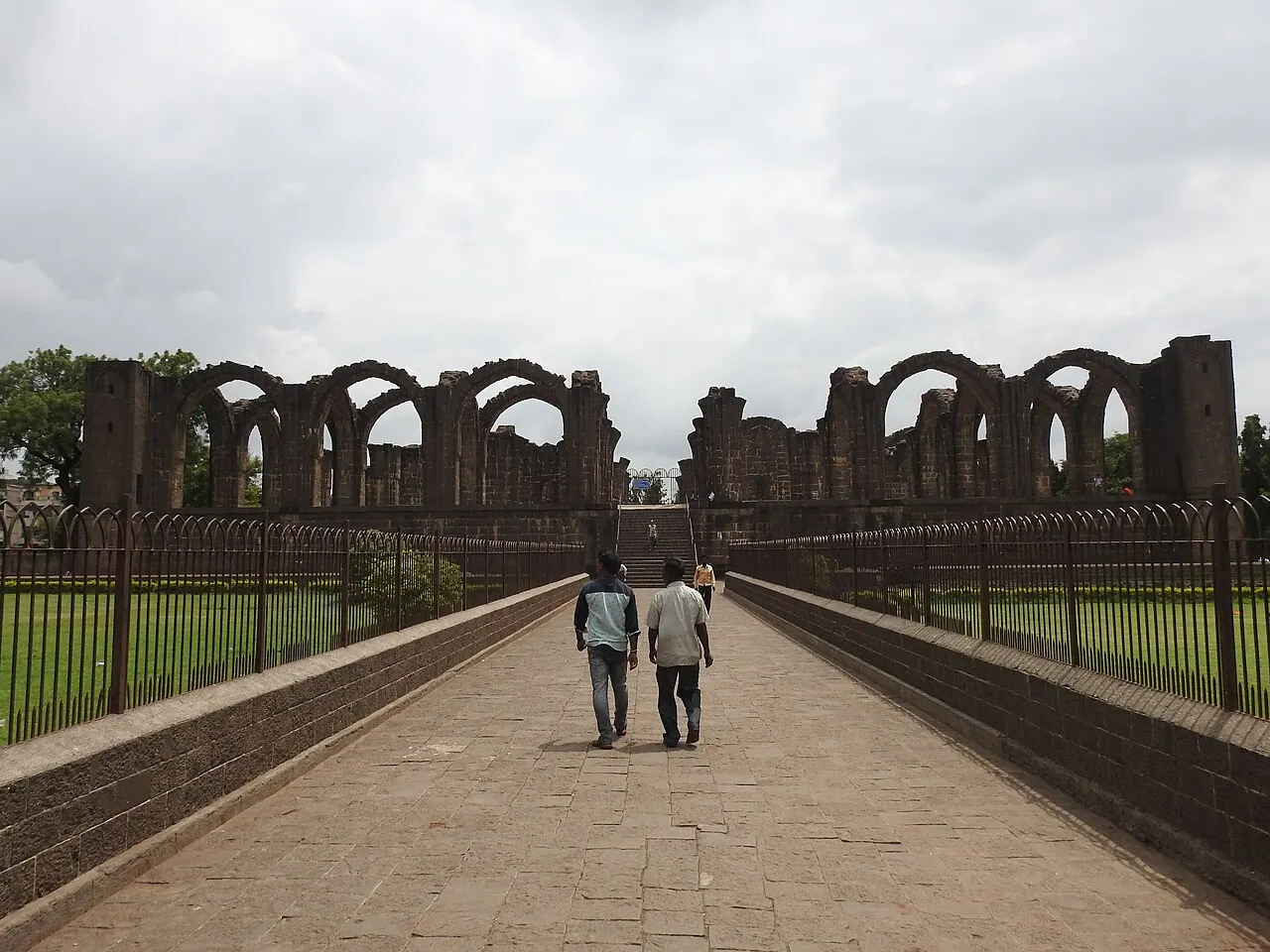
- 1672Death of Ali II; the unfinished tomb-court of Bara Kaman is left as it stands.
- 1685Aurangzeb opens the siege of Bijapur in March.
- 12 Sept 1686Surrender of Sikandar Adil Shah; the dynasty ends after 196 years.[4]
- 1724Mughal authority in the Deccan collapses; Bijapur passes between Marathas and the new Asaf Jahi state.
- 1818Annexed by the British East India Company after the Third Anglo-Maratha War.
- 1 Nov 1956States Reorganisation transfers Bijapur from Bombay State to Mysore (Karnataka).
- 1 Nov 2014The city is officially renamed Vijayapura, restoring its Chalukya-era name.
References
- ^ ^ ^ Encyclopaedia Britannica, "Adil Shahi dynasty." ↗
- ^ George Michell & Mark Zebrowski, Architecture and Art of the Deccan Sultanates (The New Cambridge History of India I.7), Cambridge University Press, 1999.
- ^ ^ UNESCO Tentative List, "Monuments and Forts of the Deccan Sultanate." ↗
- ^ ^ ^ Richard M. Eaton, A Social History of the Deccan, 1300–1761: Eight Indian Lives, Cambridge University Press, 2005.
- ^ ^ H. K. Sherwani & P. M. Joshi (eds.), History of Medieval Deccan (1295–1724), 2 vols., Government of Andhra Pradesh, Hyderabad, 1973–74.
Compiled and edited by Syed Azhar Farhan for Dakhni.org from the sources cited on this page. AI may assist research and drafting; see the editorial method, corrections log, and AI policy.
Comments
Comments are provided by Disqus. Loading them shares your visit with Disqus.